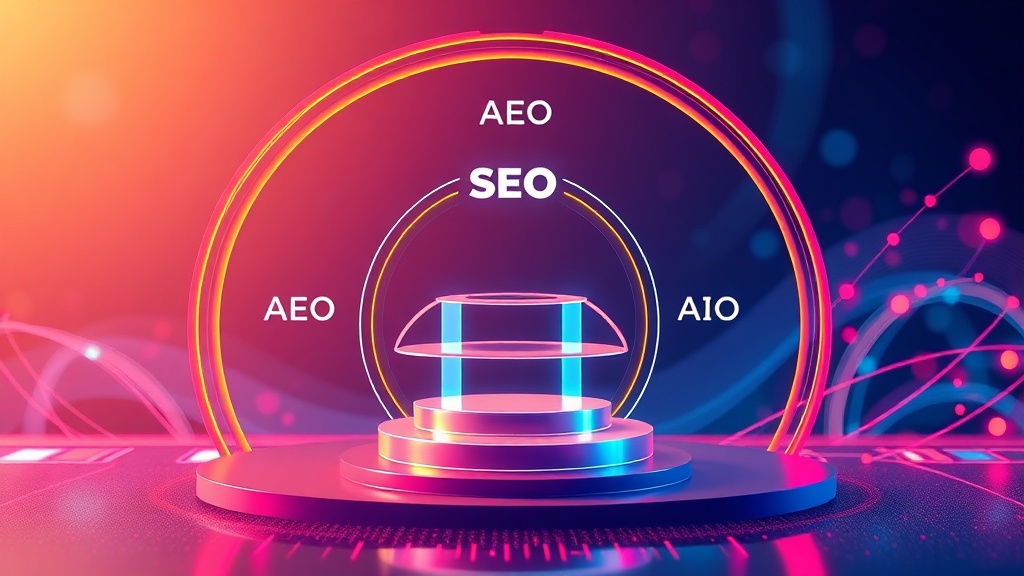
Introduction to Holistic Digital Optimization
Holistic digital optimization represents a synergistic approach to content strategy, integrating traditional Search Engine Optimization with newer paradigms like Answer Engine Optimization, Geographic Optimization, and Artificial Intelligence Optimization to achieve maximum visibility and relevance across diverse digital landscapes.
The digital realm is an ever-evolving ecosystem, where visibility and relevance are the ultimate currencies. As search engines become more sophisticated and user behaviors shift towards conversational interfaces and localized queries, a static approach to content optimization is no longer sufficient. Modern content strategists must embrace a multi-faceted methodology that transcends conventional Search Engine Optimization (SEO), integrating Answer Engine Optimization (AEO), Geographic Optimization (GEO), and Artificial Intelligence Optimization (AIO) into a unified, powerful strategy. This article will dissect each of these critical pillars and demonstrate how their symbiotic integration creates a resilient and future-proof digital presence.
The Shifting Search Landscape
Traditional keyword matching, while still important, has broadened significantly. Search engines now prioritize user intent, semantic understanding, and rich, contextual answers. The rise of voice search, personal assistants like Google Assistant and Siri, and advanced AI models means that content must be optimized not just for algorithms, but for direct answers and machine interpretability. This shift necessitates a deeper understanding of how information is processed and delivered, moving beyond simple ranking metrics to encompass comprehensive digital presence across all interaction points.
Search Engine Optimization (SEO): The Foundation
SEO remains fundamental by optimizing website content and technical infrastructure for algorithms like Google Search and Bing Search, focusing on organic visibility through keyword research, technical SEO, on-page optimization, and off-page signals to rank highly in SERPs.
At its core, SEO ensures that your content is discoverable by traditional search engines. It’s the bedrock upon which all other optimization efforts are built. A robust SEO strategy encompasses a wide array of tactics designed to improve organic rankings and drive qualified traffic to your digital properties.
Keyword Research and Intent Mapping
Understanding searcher intent is paramount. Keyword research involves identifying the terms and phrases users employ to find information, products, or services. Tools like Google Keyword Planner, Semrush, and Ahrefs facilitate this. Beyond volume, mapping keywords to user intent—informational, navigational, transactional, or commercial investigation—guides content creation. For instance, ‘how to tie a knot’ indicates informational intent, whereas ‘buy climbing rope’ signifies transactional intent. Effective intent mapping ensures content directly addresses user needs, leading to higher engagement and conversion rates.
- Informational intent: Users seeking knowledge or answers to specific questions.
- Navigational intent: Users looking for a specific website or brand.
- Transactional intent: Users ready to make a purchase or take a specific action.
- Commercial investigation intent: Users researching products or services before a purchase.
Technical SEO Imperatives
Technical SEO focuses on website infrastructure elements that affect crawlability and indexability. This includes ensuring a site has a clear site architecture, optimized XML sitemaps, and a robots.txt file that directs search engine bots. Core Web Vitals, encompassing Largest Contentful Paint (LCP), First Input Delay (FID), and Cumulative Layout Shift (CLS), are critical for user experience and ranking. Other aspects include mobile-friendliness, secure HTTPS protocols, canonical tags to prevent duplicate content issues, and efficient internal linking structures. A technically sound website provides a smooth experience for both users and search engine crawlers.
On-Page and Off-Page Strategies
On-page SEO involves optimizing elements directly on your web pages. This includes crafting compelling meta titles and meta descriptions, strategically placing keywords within headings (h1, h2, h3) and body text, optimizing image alt text, and ensuring high-quality, semantically rich content. User experience (UX) signals like dwell time and bounce rate also play a role. Off-page SEO refers to actions taken outside your website to improve its ranking. The most prominent off-page factor is backlink acquisition, where high domain authority websites link to your content, signaling authority and trustworthiness to search engines. Social media signals and brand mentions also contribute to off-page authority.
Answer Engine Optimization (AEO): Catering to Conversational Search
AEO optimizes content specifically for direct answers provided by AI assistants, voice search devices like Amazon Alexa and Google Assistant, and featured snippets, aiming to deliver concise, authoritative, and fact-based responses to user queries, moving beyond traditional ten-blue-link results.
As AI-powered assistants and conversational search become prevalent, the goal shifts from merely appearing in search results to directly answering user questions. AEO is about being the definitive, quotable source for specific queries, often manifesting as featured snippets or direct voice responses.
Understanding Featured Snippets and Direct Answers
Featured snippets, often called ‘position zero,’ are prominent boxes at the top of Google’s Search Engine Results Pages (SERPs) that directly answer a user’s query. These can take various forms: paragraph snippets, bulleted lists, numbered lists, and tables. Winning a featured snippet significantly boosts visibility, often leading to a ‘zero-click’ search result where the user finds their answer without visiting the website. AEO strategies actively target these by providing clear, concise, and accurate answers immediately following a question within content.
Optimizing for Voice Search and AI Assistants
Voice search queries tend to be longer, more conversational, and question-based (e.g., ‘What is the capital of France?’ rather than ‘capital France’). Optimizing for voice involves using natural language processing (NLP) to understand query patterns, incorporating long-tail keywords, and structuring content with a question-and-answer format. For AI assistants, schema markup, specifically speakable schema, can explicitly tell devices which parts of your content are suitable for audio output. Ensuring content addresses common questions directly and concisely is paramount for AEO.
Content Structuring for Q&A Formats
To excel in AEO, content must be structured to facilitate easy extraction of answers. This often means placing a direct, concise answer immediately after a clear question (e.g., in an h2 or h3 tag). Using descriptive headings, creating dedicated FAQ sections, and employing clear definitions for key terms helps algorithms identify and present answers efficiently. Implementing FAQPage schema markup can further enhance a page’s chances of appearing as a rich result or featured snippet, directly addressing common user questions in a machine-readable format.
Geographic Optimization (GEO): Localizing Your Digital Footprint
GEO focuses on enhancing visibility for location-specific queries, crucial for businesses with physical presences, by leveraging platforms like Google Business Profile, local citations, geotagged content, and local schema markup to attract customers in specific geographic regions.
For businesses serving specific geographic areas, GEO is indispensable. It ensures that when users search for products or services ‘near me’ or within a particular city, your business appears prominently. This is vital for local foot traffic and service area businesses.
Google Business Profile Mastery
Google Business Profile (GBP) is the cornerstone of local SEO. Optimizing your GBP listing with accurate Name, Address, Phone number (NAP), business hours, services, photos, and regular posts significantly impacts local pack rankings. Encouraging and responding to customer reviews, using relevant categories, and ensuring all information is consistent across the web are critical for maximizing local visibility. An optimized GBP acts as a digital storefront, drawing in local customers.
Local Citations and Review Management
Local citations are mentions of your business’s NAP on other websites, directories, and social media platforms. Consistency of NAP data across all online properties (e.g., Yelp, Facebook, Yellow Pages) is crucial for building trust with search engines. Discrepancies can confuse algorithms and harm local rankings. Proactive review management, including encouraging positive reviews and thoughtfully responding to all feedback, improves local search visibility and builds customer confidence. High ratings and a large volume of reviews are strong local ranking signals.
Geotagged Content and Local Schema
Creating location-specific content, such as blog posts about local events, community guides, or dedicated landing pages for each service area, strengthens GEO efforts. Geotagged images and videos embedded on your site also provide location signals. Implementing LocalBusiness schema markup on relevant pages provides search engines with explicit information about your business’s location, services, opening hours, and contact details in a structured format. This structured data is key to helping search engines understand and display your business information accurately for local searches.
Artificial Intelligence Optimization (AIO): Preparing for the Future
AIO is a forward-looking strategy that anticipates how AI models, including large language models (LLMs) and generative AI, consume, interpret, and generate content, optimizing for clarity, factual accuracy, semantic density, and machine learning model compatibility rather than just human readability.
As AI continues to integrate into search and content consumption, optimizing for these intelligent systems becomes paramount. AIO prepares your content for a future where AI might be the primary intermediary between users and information, focusing on content that is digestible and trustworthy for machine learning models.
Content for Generative AI and LLMs
Generative AI models, such as GPT-4, consume vast amounts of internet data to learn patterns and generate responses. AIO involves crafting content that is clear, factually grounded, and semantically dense, making it easy for LLMs to extract core information without misinterpretation. This means avoiding ambiguity, using precise language, and ensuring the logical flow of arguments. Content that is well-organized and authoritative becomes a reliable source for AI, increasing its chances of being cited or influencing AI-generated summaries and answers.
Data Structure and Knowledge Graph Integration
The semantic web principles are central to AIO. Optimizing for AI means making your content understandable beyond keywords, focusing on the relationships between entities and concepts. Implementing structured data using JSON-LD, leveraging vocabularies like Schema.org, allows you to explicitly define entities (people, places, organizations, products) and their properties and relationships. This feeds directly into knowledge graphs, which are powerful databases used by AI to understand the world. By contributing to the knowledge graph, your content becomes a trusted data point for AI systems.
Ethical AI Content Considerations
AIO also encompasses ethical considerations. As AI relies on existing data, it can perpetuate biases or misinformation. Content creators must prioritize factual accuracy, diversity, and responsible data sourcing to avoid contributing to harmful AI outputs. Transparency about content provenance and adherence to journalistic integrity are crucial. Ensuring content is unbiased and represents a range of perspectives is not only ethical but also future-proofs content against potential algorithmic penalties or reduced trust from increasingly discerning AI systems.
Integrating the Four Pillars: A Unified Strategy
A unified digital strategy harmonizes SEO, AEO, GEO, and AIO by ensuring content is discoverable (SEO), answerable (AEO), locally relevant (GEO), and AI-consumable (AIO), creating a robust, resilient digital presence that maximizes reach across all current and future search modalities.
The true power of advanced content optimization lies in the synergistic integration of these four pillars. Treating them as isolated strategies will lead to fragmented results. A holistic approach ensures that every piece of content works harder, performing across multiple dimensions simultaneously.
Cross-Pillar Content Synergy
Consider a blog post for a local bakery: the content should be optimized with relevant keywords (SEO) like ‘artisan bread near me,’ feature a clear recipe or definition that could become a featured snippet (AEO), include the bakery’s address and map embedded with local schema (GEO), and be written with clear, unambiguous language suitable for an LLM to summarize (AIO). A single piece of content, when optimized synergistically, achieves maximum impact across all search modalities. This integrated approach ensures content isn’t just ranking, but also answering questions, attracting local customers, and feeding intelligent systems.
Data-Driven Decision Making
Effective integration requires a robust analytics framework. Leveraging platforms like Google Analytics 4, Google Search Console, and proprietary AEO/GEO tools allows strategists to monitor performance across all four pillars. Analyzing organic traffic from traditional search (SEO), impressions and click-through rates for featured snippets (AEO), local pack visibility and calls from Google Business Profile (GEO), and patterns in AI-driven content consumption (AIO) provides a complete picture. This data informs iterative refinements, ensuring the strategy remains agile and responsive to algorithmic shifts and user behavior changes.
Prioritization Matrix
| Optimization Type | Primary Goal | Key Tactics | Impact Area |
|---|---|---|---|
| SEO | Organic Search Visibility | Keyword Research, Technical SEO, Link Building | SERPs, Website Traffic |
| AEO | Direct Answers & Featured Snippets | Q&A Formatting, Concise Content, Speakable Schema | Voice Search, AI Assistants, Position Zero |
| GEO | Local Search Prominence | Google Business Profile, Local Citations, Local Schema | ‘Near Me’ Searches, Local Pack, Maps |
| AIO | AI Interpretability & Trust | Semantic Clarity, Structured Data, Factual Accuracy | LLMs, Knowledge Graphs, Generative AI |
Technical Content Architecture for Machine Readability
Technical content architecture ensures information is structured optimally for machine processing, leveraging HTML semantic elements, structured data formats like Schema.org JSON-LD, and modular content design to enhance discoverability, interpretability, and reusability across diverse AI and search systems.
Beyond the textual content, how that content is structured within your HTML and data layers is crucial. Machines ‘read’ the web differently than humans, relying on explicit signals to understand context, hierarchy, and relationships. A robust technical architecture supports all four optimization pillars.
Semantic HTML and Information Hierarchy
Using correct HTML semantic elements and maintaining a clear information hierarchy are fundamental. Heading tags (h1, h2, h3) should logically structure content, guiding both human readers and search engine crawlers. HTML5 semantic elements like article, section, nav, and aside provide explicit meaning to content blocks, helping machines understand their purpose. This foundational structure improves accessibility, readability, and the ability of algorithms to correctly parse and categorize information, boosting SEO and AEO efforts.
Structured Data Implementation (JSON-LD)
Structured data, particularly using JSON-LD and Schema.org vocabularies, is a powerful tool to communicate explicit facts to machines. It provides context and meaning to your content that might otherwise be ambiguous. For example, using Article schema tells search engines that a page is a blog post, while Product schema details price, availability, and reviews. FAQPage schema assists AEO, and LocalBusiness schema bolsters GEO. Proper implementation of structured data enhances rich snippets, improves AI’s understanding of your content, and strengthens your presence in the knowledge graph.
Modular Content Design and API First Approach
Modular content design involves breaking down content into discrete, reusable components rather than monolithic pages. This ‘API first’ approach treats content as data that can be delivered across various channels and platforms seamlessly. Using a headless CMS (Content Management System) facilitates this, allowing content to be created once and then dynamically deployed to a website, mobile app, voice assistant, or AI model. This enhances content reusability, consistency, and scalability, making it inherently more adaptable to future AI and search modalities.
Measuring Success and Iterative Refinement
Measuring success in advanced content optimization involves analyzing key performance indicators (KPIs) like organic traffic, featured snippet impressions, local search visibility, and AI engagement rates using tools such as Google Search Console, Google Analytics, and specialized AEO/GEO platforms for continuous iterative refinement.
Optimization is not a one-time task; it’s an ongoing process of monitoring, analysis, and refinement. A robust measurement framework is essential to understand the impact of your integrated strategy and identify areas for improvement.
Key Performance Indicators (KPIs)
KPIs for advanced content optimization extend beyond traditional organic traffic. For SEO, track organic click-through rate (CTR), keyword rankings, and page speed. For AEO, monitor featured snippet impressions, ‘position zero’ wins, and voice search traffic. GEO requires tracking local pack rankings, Google Business Profile insights (calls, map requests), and local citation consistency. AIO’s success can be gauged by content’s influence on generative AI outputs (though harder to directly measure), structured data validation, and knowledge graph presence. A holistic dashboard combining these metrics provides comprehensive insights.
- SERP visibility: Overall presence in search engine results.
- Organic traffic: Number of visitors from unpaid search results.
- Featured snippet rate: Frequency of content appearing in position zero.
- Local pack ranking: Position within local search results.
- Structured data validation: Ensuring JSON-LD implementation is error-free.
Analytics and Reporting Tools
Leverage tools such as Google Search Console for detailed query performance, crawl errors, and rich result status. Google Analytics provides comprehensive user behavior data, conversion tracking, and traffic source analysis. Specialized local SEO tools (e.g., BrightLocal, Semrush’s Local SEO Toolkit) monitor local rankings and citations. Keeping an eye on emerging AI tools and platforms that analyze content consumption by LLMs will become increasingly important for AIO. Regular reporting and analysis are critical for informed decision-making.
A/B Testing and Algorithm Adaptation
The digital landscape is constantly changing, with search algorithms undergoing frequent updates. An iterative refinement process involves continuous A/B testing of headlines, meta descriptions, content formats, and structured data implementations to identify what performs best. Staying informed about algorithm updates from Google and other platforms is crucial. Adapting your strategy proactively, rather than reactively, ensures long-term digital resilience and sustained competitive advantage across all four pillars of optimization.
Conclusion: The Future of Digital Content
The future of digital content demands a proactive, integrated optimization strategy that transcends traditional SEO, embracing AEO, GEO, and AIO to ensure content remains discoverable, authoritative, and relevant in a landscape increasingly dominated by AI, voice, and intelligent agents.
The journey towards digital dominance is ongoing, requiring vigilance, adaptability, and a deep understanding of the intricate mechanisms that govern online visibility. By mastering the integration of SEO, AEO, GEO, and AIO, organizations can construct a robust and resilient digital presence. This holistic approach ensures content is not only found by today’s users but is also positioned to thrive in an increasingly intelligent and interconnected digital future. The content architect of tomorrow must be a universal strategist, building bridges between human intent and machine understanding, ensuring every digital asset contributes to a powerful, unified narrative in the global information landscape.