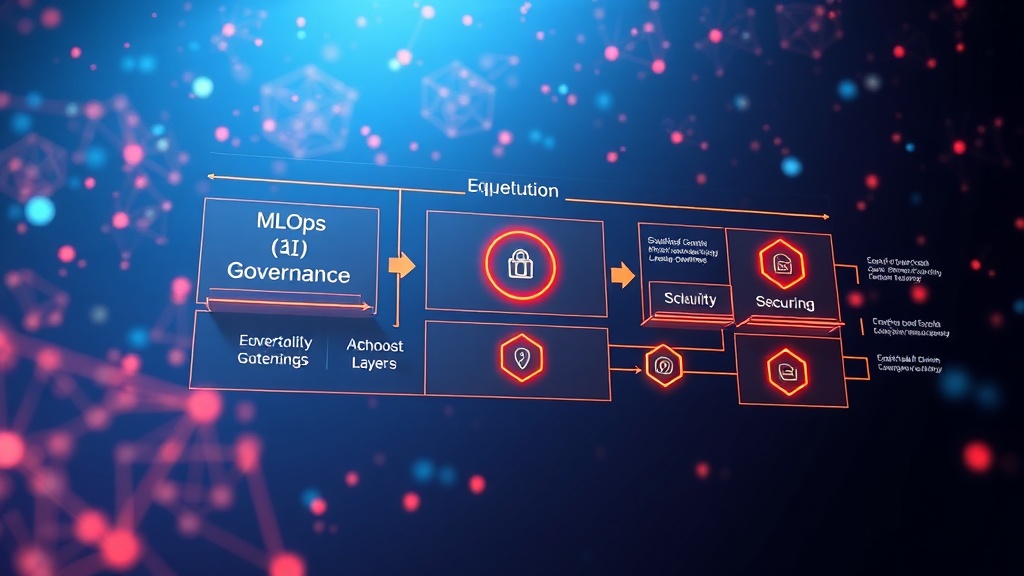
The rapid evolution of artificial intelligence (AI) has positioned it as a transformative force across all industries. For enterprises, however, merely adopting AI tools is insufficient; true competitive advantage stems from architecting next-generation AI solutions that are inherently scalable, rigorously secure, and ethically sound. This requires a holistic strategy, moving beyond siloed data science projects to integrated platforms that can sustain innovation, mitigate risks, and align with corporate values. A successful AI blueprint demands meticulous planning, robust infrastructure, stringent governance, and a commitment to responsible deployment, ensuring that AI investments deliver tangible, lasting value while navigating the complex technical and ethical landscape.
Foundation for Scalability: Robust MLOps and Infrastructure
Establishing scalable AI necessitates a robust MLOps framework that automates the machine learning lifecycle, from data ingestion and model training to deployment and monitoring. This includes leveraging cloud-native services for elastic compute and storage, ensuring reproducible workflows, and managing model versions effectively across development and production environments.
Automated MLOps Pipelines
Achieving AI scalability begins with automating the entire machine learning lifecycle through well-defined MLOps pipelines. This involves integrating Continuous Integration/Continuous Delivery (CI/CD) practices, common in traditional software development, but adapted for the unique demands of machine learning models. Key components include automated data validation, feature engineering, model training, hyperparameter tuning, and a model registry for versioning and lineage tracking. Tools like Kubeflow, MLflow, and SageMaker Pipelines facilitate these processes, ensuring reproducibility and reducing manual intervention. Furthermore, comprehensive experiment tracking is crucial for comparing model performance and selecting optimal candidates for deployment, enabling rapid iteration and refinement.
Cloud-Native Architecture for AI
Cloud-native architectures are foundational for scalable AI deployments, offering elastic compute, storage, and specialized hardware on demand. Enterprises often leverage containerization technologies such as Docker, orchestrated by Kubernetes, to package AI models and their dependencies into portable, reproducible units. This enables seamless deployment across various environments, from on-premise clusters to public clouds like Amazon Web Services (AWS), Microsoft Azure, and Google Cloud Platform (GCP). For computationally intensive tasks, cloud providers offer access to specialized hardware, including Graphics Processing Units (GPUs) and Tensor Processing Units (TPUs), significantly accelerating model training and inference. Data Lakes and Lakehouses, built on technologies like Delta Lake, Apache Hudi, or Apache Iceberg, provide flexible storage layers capable of handling vast volumes of structured and unstructured data, essential for fueling complex AI models while offering ACID transactions for data reliability.
Fortifying AI: Comprehensive Security and Data Privacy
Securing AI systems requires a multi-layered approach encompassing data-at-rest and in-transit encryption, robust access controls, and protection against adversarial attacks. Adhering to regulations like GDPR and CCPA is paramount, necessitating privacy-preserving techniques such as federated learning and differential privacy throughout the AI lifecycle.
Data Security and Access Control
At the core of AI security is the protection of sensitive data. Implementing strong encryption protocols, such as AES-256 for data-at-rest and TLS/SSL for data-in-transit, safeguards information from unauthorized access. Granular access controls, including Role-Based Access Control (RBAC) and Attribute-Based Access Control (ABAC), ensure that only authorized personnel and services can access specific data sets or models. Secure API gateways are critical for controlling and monitoring all interactions with AI services, providing authentication, authorization, and rate limiting. Continuous vulnerability scanning and penetration testing of AI infrastructure and applications are essential practices to identify and remediate potential security gaps proactively.
Threat Modeling and Adversarial AI
AI systems introduce unique security vulnerabilities beyond traditional software. Threat modeling, such as the STRIDE model (Spoofing, Tampering, Repudiation, Information Disclosure, Denial of Service, Elevation of Privilege), must be extended to account for AI-specific attacks. Adversarial AI techniques include data poisoning, where malicious data is injected into training sets to compromise model integrity; model evasion, where inputs are subtly altered to trick a trained model; and model inversion attacks, which attempt to reconstruct training data from model outputs. Defending against these threats involves employing adversarial training, where models are trained on both clean and perturbed data, and gradient masking, which obfuscates model gradients to make attacks harder to craft. Homomorphic encryption also offers potential for secure computation on encrypted data.
Regulatory Compliance and Privacy-Preserving AI
Navigating the complex landscape of data privacy regulations, such as the General Data Protection Regulation (GDPR), California Consumer Privacy Act (CCPA), and Health Insurance Portability and Accountability Act (HIPAA), is non-negotiable for enterprise AI. Compliance requires robust data anonymization, pseudonymization, and strict consent management. Privacy-preserving AI techniques are emerging as critical enablers. Federated Learning allows models to be trained on decentralized data sources without centralizing the raw data, preserving individual privacy. Differential Privacy adds controlled noise to data or query results, making it difficult to infer information about any single individual. These methods are crucial for leveraging sensitive data while maintaining regulatory adherence and public trust.
Guiding Principles: Ethical AI and Responsible Governance
Implementing ethical AI involves establishing clear governance frameworks that address fairness, transparency, accountability, and human oversight. This includes developing internal policies, performing regular bias detection and mitigation, and ensuring explainability (XAI) for critical decision-making processes, fostering trust and societal acceptance.
Establishing Ethical AI Frameworks
Responsible AI governance begins with establishing explicit ethical AI frameworks and policies. This often involves creating an internal AI ethics board or committee comprising diverse stakeholders from legal, compliance, data science, and business units. These bodies define organizational principles that align with global guidelines, such as the NIST AI Risk Management Framework, focusing on human agency, technical robustness, safety, privacy, transparency, fairness, and accountability. These principles should permeate the entire AI lifecycle, from ideation to deployment and decommissioning, ensuring ethical considerations are embedded by design rather than as an afterthought.
Bias Detection and Mitigation
Algorithmic bias is a significant concern in AI, often stemming from biased training data (e.g., selection bias, reporting bias, historical bias) or inherent algorithmic properties. Detecting bias requires systematic evaluation using fairness metrics such as demographic parity, equal opportunity, and disparate impact. Mitigation techniques vary depending on the stage of the AI pipeline. Pre-processing methods include re-weighting or sampling to balance sensitive attribute groups in the data. In-processing methods involve modifying the learning algorithm itself, such as fairness-aware regularizers. Post-processing techniques adjust model predictions to achieve desired fairness criteria. Continuous monitoring for bias in deployed models is vital, as data distributions and societal contexts can evolve.
Explainable AI (XAI) and Transparency
For AI systems making critical decisions, especially in regulated industries like finance or healthcare, explainability is paramount. Explainable AI (XAI) aims to make AI models’ decisions comprehensible to humans. This contrasts with traditional ‘black-box’ models like deep neural networks. Techniques such as LIME (Local Interpretable Model-agnostic Explanations) and SHAP (SHapley Additive exPlanations) provide local explanations for individual predictions, revealing feature importance. Other approaches focus on building inherently interpretable models like decision trees or linear models. Transparency ensures that stakeholders understand how AI systems operate, their limitations, and the rationale behind their outputs, fostering trust and enabling effective human oversight and intervention when necessary.
| XAI Technique | Explanation Scope | Interpretability Type |
|---|---|---|
| LIME | Local (individual predictions) | Model-agnostic |
| SHAP | Local and Global | Model-agnostic, Game Theory based |
| Permutation Importance | Global (feature importance) | Model-agnostic |
| Partial Dependence Plots | Global (feature effects) | Model-agnostic |
Operationalizing AI: Performance Monitoring and AIOps
Operationalizing AI demands continuous performance monitoring to detect model drift, data drift, and anomalies, ensuring sustained accuracy and relevance. Leveraging AIOps principles automates incident response, root cause analysis, and predictive maintenance for AI infrastructure and applications, optimizing operational efficiency.
Continuous Model Monitoring
Once deployed, AI models are not static; their performance can degrade over time due to shifts in data distributions or underlying relationships. Continuous model monitoring is essential for detecting phenomena like data drift (changes in input data characteristics) and concept drift (changes in the relationship between input features and target variable). Key performance metrics such as accuracy, precision, recall, F1-score, and AUC-ROC must be tracked against a baseline. Anomaly detection algorithms can identify unusual model behavior or output patterns. Proactive alerts and dashboards provide visibility into model health, triggering retraining or recalibration processes before significant performance degradation impacts business outcomes.
AIOps for Predictive Maintenance and Anomaly Detection
AIOps, the application of AI to IT operations, is critical for managing the complexity of AI infrastructure and applications. By ingesting vast amounts of operational data—including logs, metrics, and events—from various sources (e.g., servers, networks, applications), AIOps platforms can perform real-time log aggregation and analysis, often leveraging tools like the ELK Stack (Elasticsearch, Logstash, Kibana) or Splunk. Machine learning models within AIOps can then detect anomalies, identify correlations, and predict potential failures in the underlying infrastructure, preventing outages. This enables predictive maintenance, automated incident response, and root cause analysis, significantly reducing Mean Time To Resolution (MTTR) and optimizing the overall reliability and performance of AI systems.
Strategic Integration: Business Alignment and Change Management
Successful AI integration transcends technical implementation, requiring strong alignment with overarching business objectives and proactive change management strategies. This involves fostering an AI-first culture, reskilling workforces, and measuring AI’s tangible impact on key performance indicators (KPIs) to drive sustained value and adoption.
Business Value Realization
The ultimate goal of enterprise AI is to drive business value. This necessitates defining clear, measurable return on investment (ROI) metrics for every AI initiative, linking AI outcomes directly to strategic business objectives such as cost reduction, revenue growth, customer experience enhancement, or innovation. Starting with pilot programs and adopting an iterative deployment approach allows organizations to test hypotheses, gather feedback, and demonstrate value incrementally. Successful value realization also involves identifying and prioritizing use cases where AI can deliver the most significant impact, moving beyond ‘proofs of concept’ to full-scale operationalization that integrates AI into core business processes.
Organizational Readiness and Upskilling
Implementing next-generation AI requires a significant shift in organizational capabilities. Fostering data literacy and AI literacy across the enterprise is crucial, enabling employees to understand AI’s potential, limitations, and ethical implications. This includes upskilling existing workforces through training programs that cover data science fundamentals, machine learning engineering, and ethical AI practices. Promoting cross-functional collaboration between data scientists, machine learning engineers, business analysts, domain experts, and legal teams ensures that AI solutions are not only technically sound but also strategically relevant and ethically compliant. A culture that embraces experimentation, continuous learning, and adapts to AI-driven workflows is vital for long-term success.
Change Management and Stakeholder Engagement
Successful AI adoption is as much about people as it is about technology. Effective change management strategies are essential to navigate organizational resistance, address concerns about job displacement, and build trust in AI systems. This involves transparent communication of AI’s benefits, clearly articulating how AI will augment human capabilities rather than replace them. Early and continuous engagement with all stakeholders—from front-line employees to senior leadership—is critical to foster buy-in and ownership. Establishing clear governance structures that include stakeholder input ensures that AI development is guided by collective insights and adheres to organizational values, ultimately leading to greater acceptance and sustained utilization of AI solutions.
Architecting next-generation AI for the enterprise is a complex, multifaceted undertaking that demands strategic foresight, technical prowess, and a steadfast commitment to ethical principles. By establishing robust MLOps, fortifying security, embedding ethical governance, and aligning AI initiatives with core business objectives, organizations can unlock AI’s full potential. The journey requires continuous adaptation, upskilling, and a culture that embraces intelligent automation. As AI technologies continue to advance, enterprises that prioritize a scalable, secure, and ethical framework will be best positioned to lead their respective industries, driving innovation and shaping a responsible AI-powered future.