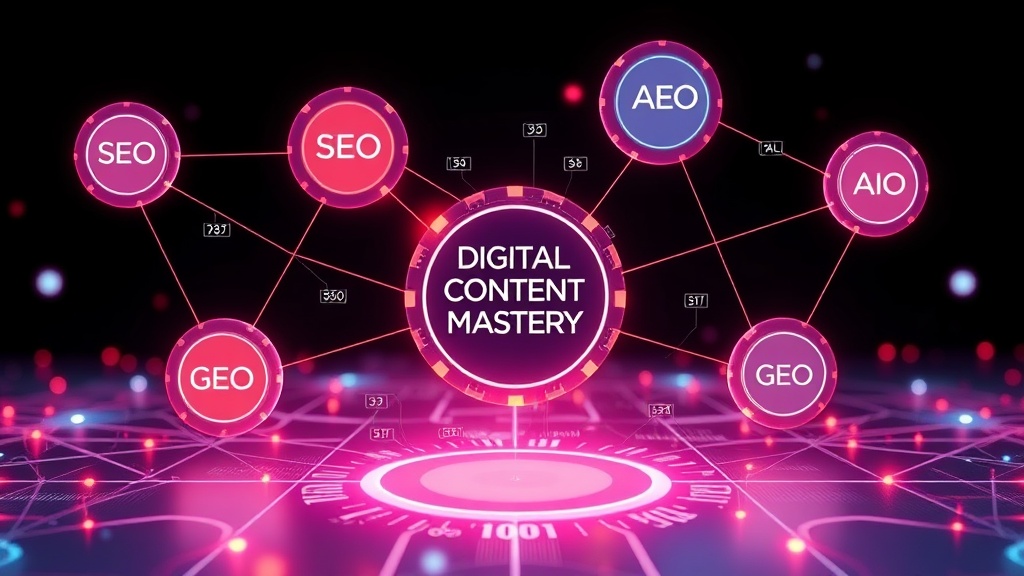
In the dynamic realm of digital presence, content is no longer merely king; it is the entire kingdom. For businesses and individual brands alike, navigating the intricate labyrinth of search engine algorithms, user expectations, and emerging technologies requires a strategic framework rooted in advanced content mastery. This guide delves into the sophisticated methodologies that underpin peak performance in digital content, encompassing the critical elements of SEO, AEO, GEO, and AIO, ensuring your digital assets not only reach their intended audience but also resonate deeply and convert effectively.
The Evolving Landscape of Digital Content
The digital content landscape is rapidly evolving, driven by advancements in artificial intelligence, changes in user behavior, and sophisticated search engine algorithms. Content mastery now demands a holistic approach, integrating technical precision with profound strategic insight to navigate algorithmic shifts and engage increasingly discerning audiences effectively.
From Keyword Stuffing to Semantic Understanding
Gone are the days when simply saturating content with keywords guaranteed visibility. Modern search engines, powered by sophisticated Natural Language Processing (NLP) models like BERT and MUM, prioritize semantic understanding. This means they interpret the intent behind queries and the contextual relevance of content, rather than just matching exact phrases. Content strategists must now focus on creating comprehensive, topically authoritative content that addresses the full spectrum of a user’s potential queries around a given subject, establishing a robust semantic network.
The Rise of Conversational Search and AI Integration
The proliferation of voice assistants (e.g., Google Assistant, Amazon Alexa) and large language models (LLMs) has ushered in the era of conversational search. Users now pose natural language questions, expecting direct and concise answers. This shift necessitates content that is structured to provide clear, immediate solutions, often leveraging question-and-answer formats and summary capsules. AI integration in content creation and optimization is also becoming standard, assisting in keyword research, content generation outlines, and performance analysis.
Foundational Pillars of Modern SEO
Modern SEO transcends mere keyword stuffing, focusing instead on comprehensive technical optimization, user experience, and establishing genuine authority. Key foundational pillars include semantic SEO, Core Web Vitals, mobile-first indexing, and robust structured data implementation, all critical for superior organic visibility and sustained search performance.
Technical SEO for Optimal Crawlability and Indexing
At the core of any successful digital strategy lies a meticulously optimized technical infrastructure. This includes ensuring XML sitemaps are accurate and submitted to Google Search Console, robots.txt directives are correctly configured to guide crawler bots, and canonical tags prevent duplicate content issues. Site speed, measured by metrics like Largest Contentful Paint (LCP) and First Input Delay (FID), is paramount, as slow loading times significantly impact user experience and bounce rates. A secure HTTPS protocol is non-negotiable for trust and ranking.
Core Web Vitals and User Experience Signals
Google’s Core Web Vitals (LCP, FID, CLS – Cumulative Layout Shift) are direct measures of user experience on a web page. Optimizing these metrics is crucial for improved search rankings. LCP focuses on loading performance, FID on interactivity, and CLS on visual stability. Achieving ‘Good’ status across these vitals requires proactive front-end development, image optimization (next-gen formats like WebP), efficient CSS/JavaScript delivery, and minimizing layout shifts caused by dynamic content injection.
Mobile-First Indexing and Adaptive Design
With the majority of web traffic originating from mobile devices, Google’s mobile-first indexing means the mobile version of your website is primarily used for indexing and ranking. Therefore, responsive design is not merely a preference but a mandate. Content, imagery, and interactive elements must render flawlessly and perform optimally across all screen sizes, ensuring accessibility and a consistent user experience regardless of the device.
Advanced AEO and Semantic Search Integration
Advanced Answer Engine Optimization (AEO) and semantic search integration are paramount for capturing featured snippets, voice search results, and direct answers in SERPs. This involves crafting ultra-specific, intent-driven content that directly addresses user queries, leveraging natural language processing and entity relationships to enhance machine understanding and answer relevance.
Optimizing for Featured Snippets and Direct Answers
Featured snippets, often appearing as ‘Position Zero’ in Google’s SERP, provide a direct answer to a user’s query without requiring a click. To capture these, content should employ clear, concise, and structured answers to common questions. This includes using definition paragraphs, numbered or bulleted lists, and tables that directly respond to ‘What is?’, ‘How to?’, and ‘List of’ queries. The content should be succinct, factual, and backed by authority.
Voice Search and Conversational Query Optimization
Voice search queries tend to be longer, more conversational, and question-based compared to typed queries. Optimizing for voice search involves targeting long-tail keywords that mimic natural speech patterns, structuring content in a Q&A format, and ensuring answers are brief and to the point. Understanding the intent behind these natural language queries, often informational or navigational, is key to providing relevant responses.
GEO: Pinpointing Audience and Local Relevance
Geographic Optimization (GEO) focuses on delivering hyper-relevant content to specific regional audiences, crucial for local businesses and global enterprises with localized offerings. This strategy involves optimizing for local keywords, establishing Google Business Profile presence, collecting localized reviews, and ensuring schema markup reflects geographic entities and service areas accurately.
Local SEO and Google Business Profile
For businesses serving specific geographic areas, optimizing for local search is non-negotiable. A fully optimized Google Business Profile (GBP) listing is the cornerstone, ensuring accurate business information (Name, Address, Phone – NAP), service descriptions, hours, and photos. Regular posting of updates, responding to reviews, and leveraging local keyword phrases within content and GBP descriptions significantly boost local visibility.
Location-Specific Content and Schema Markup
Creating content tailored to specific locations, such as ‘best plumbers in [city name]’ or ‘things to do in [region]’, helps establish geographic relevance. Incorporating local landmarks, events, and community news further enhances this. Implementing Schema.org markup for local business types, addresses, and service areas provides explicit geographic signals to search engines, improving local pack rankings and knowledge panel presence.
AIO: Architecting for Machine Readability and Engagement
Artificial Intelligence Optimization (AIO) emphasizes structuring content for maximum machine readability and user engagement, leveraging modular HTML, clear hierarchies, and interactive elements. This approach ensures AI algorithms can efficiently parse, understand, and rank content, while simultaneously providing an intuitive and satisfying experience for human users across diverse devices and platforms.
Modular Content Structure and HTML Semantics
Modular content, built with clear headings (h1, h2, h3), lists (ul, ol), and distinct paragraphs, facilitates easier parsing by AI algorithms. Utilizing semantic HTML5 tags like article, section, aside, and nav helps explicitly define content regions, providing additional contextual cues to search engines. This structured approach not only aids machine understanding but also improves readability and navigation for human users.
Schema Markup for Enhanced AI Understanding
Schema.org structured data, such as Article, FAQPage, HowTo, Product, and LocalBusiness markup, is critical for AIO. By embedding this standardized vocabulary, you provide explicit information about your content to search engines, enabling them to understand entities, relationships, and context more deeply. This can lead to rich results in SERPs, including star ratings, pricing, and direct answers, significantly increasing click-through rates.
| AIO Element | Benefit for AI Algorithms | Benefit for Human Users |
|---|---|---|
| Semantic HTML | Clear content hierarchy, context clues | Improved readability, logical flow |
| Structured Data (Schema.org) | Explicit data about entities, relationships | Rich results, quick answers, enhanced visibility |
| Modular Content | Easy parsing, extraction of key information | Scannability, faster information retrieval |
| Internal Linking | Establishes topical authority, navigational paths | Discoverability of related content, better UX |
The Strategic Role of E-A-T and Topical Authority
E-A-T (Expertise, Authoritativeness, Trustworthiness) and the cultivation of deep topical authority are critical ranking factors in Google’s Quality Rater Guidelines. Building E-A-T involves showcasing genuine expertise through author bios, citations, and comprehensive content, while topical authority requires exhaustive coverage of a subject domain, establishing a site as a go-to resource.
Establishing Expertise and Authoritativeness
To demonstrate expertise, ensure content is written by or reviewed by subject matter experts. Prominent author bios with credentials, experience, and relevant affiliations contribute significantly. External validation through mentions, citations, and backlinks from reputable sources bolsters authoritativeness. For YMYL (Your Money or Your Life) topics, this is particularly crucial, demanding verifiable factual accuracy and professional consensus.
Building Comprehensive Topical Authority
Topical authority is achieved by covering a subject exhaustively, not just superficially. This involves creating clusters of interconnected content that address every facet of a broad topic, from foundational concepts to advanced nuances. Internal linking strategies are vital here, connecting related articles and demonstrating the depth of your site’s knowledge base to search engines. Over time, this establishes your domain as a definitive resource, a ‘thought leader’ in its niche.
Measuring Success and Iterative Optimization
Effective digital content mastery requires rigorous measurement and continuous iterative optimization based on performance data and analytics. Key metrics include organic traffic, conversion rates, engagement signals like bounce rate and time on page, and backlink profiles. Regular A/B testing and content audits are essential for refining strategy and maximizing ROI.
Key Performance Indicators for Content Strategy
- Organic Traffic: Monitors visibility and reach from search engines.
- Conversion Rate: Measures the effectiveness of content in driving desired actions (e.g., sales, sign-ups).
- Engagement Metrics: Includes bounce rate, time on page, pages per session – indicating user satisfaction and content relevance.
- Backlink Profile: Quantity and quality of external links, a strong indicator of authority.
- Keyword Rankings: Tracks performance for targeted keywords and phrases.
Continuous Content Audits and Refinement
A content audit is a systematic review of all existing content to assess its performance, relevance, and accuracy. This involves identifying underperforming assets, opportunities for content refreshing or consolidation, and gaps in topical coverage. Based on audit findings and ongoing analytics, iterative optimization becomes a continuous cycle of creation, measurement, analysis, and refinement, ensuring content remains fresh, relevant, and aligned with evolving algorithmic demands and user needs.