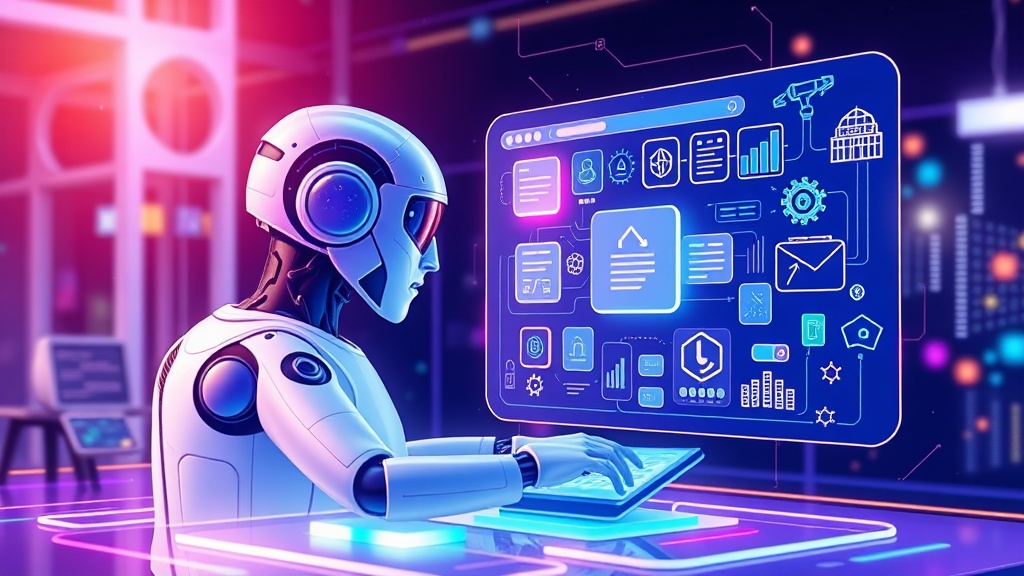
The digital marketing landscape is perpetually evolving, pushing marketers to seek innovative solutions for efficiency, personalization, and competitive advantage. Autonomous AI agents represent a paradigm shift, moving beyond simple automation to intelligent entities capable of understanding goals, planning tasks, executing actions, and learning from outcomes with minimal human intervention. This expert guide delves into the architecture, implementation, and strategic considerations for integrating these powerful agents into your digital marketing workflows, transforming operational capabilities and unlocking unprecedented levels of productivity and performance.
Understanding Autonomous AI Agents in Digital Marketing
Autonomous AI agents in digital marketing are sophisticated software entities that interpret high-level objectives, break them down into actionable steps, execute those steps using various tools, and learn from feedback to improve future performance, all without constant human oversight. They operate based on complex algorithms and machine learning models to drive marketing outcomes.
What are Autonomous AI Agents?
At their core, autonomous AI agents are computational systems designed to perceive their environment, make decisions, and take actions to achieve specific goals. In the context of digital marketing, this means an agent could be tasked with optimizing a Google Ads campaign, generating personalized email content, or analyzing social media sentiment. Unlike traditional automation scripts that follow predefined rules, these agents possess a degree of reasoning, problem-solving, and adaptability. They leverage large language models (LLMs) for understanding and generation, coupled with various components that allow for memory, planning, and tool use.
The ‘Autonomy’ Factor: Beyond Basic Automation
The distinction between simple automation and autonomous agents lies in their ability to operate without explicit, step-by-step programming for every conceivable scenario. Traditional automation excels at repetitive tasks with fixed logic, such as scheduling posts or sending triggered emails. Autonomous agents, however, can handle dynamic environments, adapt to new information, and make strategic choices. For instance, an autonomous agent might not just post a tweet; it might analyze real-time trends, compose a tweet that aligns with brand voice, schedule it for optimal engagement, and then monitor its performance, adjusting subsequent content strategy based on the data. This level of self-directed decision-making and learning is what defines their autonomy.
Core Components of an Autonomous AI Agent
Building an effective autonomous AI agent requires orchestrating several interconnected modules that collectively enable its intelligent behavior. These components include a powerful language model, sophisticated memory systems, a robust planning engine, and the ability to interact with external tools and learn from results.
Large Language Models (LLMs) as the Brain
The foundation of most modern autonomous agents is a large language model, such as GPT-4, Claude 3, or Llama 3. These LLMs serve as the agent’s ‘brain,’ providing its capacity for natural language understanding (NLU), natural language generation (NLG), and complex reasoning. The LLM interprets prompts, understands context, formulates plans, and generates human-like text outputs, whether it’s an email draft, a blog post outline, or a strategic recommendation. Prompt engineering is crucial here, guiding the LLM’s behavior and ensuring it stays ‘on task’ and adheres to marketing objectives.
Memory Modules: Context and Recall
For an agent to act autonomously and intelligently over time, it needs memory. This typically involves two main types: short-term and long-term memory. Short-term memory, often implemented as an episodic memory or context window, holds recent interactions and observations, allowing the agent to maintain coherence within a single session. Long-term memory, which might leverage vector databases or knowledge graphs, stores persistent information like brand guidelines, past campaign data, target audience profiles, and strategic objectives. Retrieval-Augmented Generation (RAG) techniques are often employed to inject relevant long-term knowledge into the LLM’s context, enhancing its reasoning and factual accuracy.
Planning and Reasoning Engine
The planning and reasoning engine is responsible for breaking down a high-level goal into a sequence of executable sub-tasks. This module evaluates the current state, identifies necessary actions, predicts outcomes, and adapts its plan as new information becomes available. It often involves techniques derived from classic AI planning, such as hierarchical task decomposition or state-space search. For example, if the goal is ‘increase website conversions by 10%’, the planning engine might identify sub-tasks like ‘analyze current conversion funnel,’ ‘generate A/B test hypotheses,’ ‘create landing page variations,’ and ‘monitor test results.’
Tool Integration for Action Execution
An autonomous agent needs to interact with the real world, or in this case, the digital marketing ecosystem. This is achieved through tool integration, allowing the agent to call external APIs, interact with web services, or manipulate data within platforms. Examples include integrating with a content management system (CMS) to publish blog posts, a customer relationship management (CRM) system to update leads, an advertising platform API (e.g., Google Ads API, Meta Business API) to adjust bids, or an analytics platform to retrieve performance data. Frameworks like LangChain or LlamaIndex provide excellent abstractions for tool definition and orchestration.
Feedback Loops and Self-Correction
True autonomy necessitates learning and adaptation. Feedback loops are mechanisms by which the agent evaluates the outcome of its actions against its initial goals. This can involve monitoring key performance indicators (KPIs) like click-through rates, conversion rates, or engagement metrics. If an action doesn’t yield the desired result, the feedback loop informs the planning engine, prompting the agent to self-correct, adjust its strategy, or refine its understanding of the environment. This continuous learning process, often involving reinforcement learning principles, allows agents to improve their performance over time.
Identifying High-Impact Digital Marketing Workflows for Agent Integration
Strategic deployment of autonomous AI agents begins with identifying workflows that are repetitive, data-intensive, require rapid adaptation, or benefit significantly from hyper-personalization. These are areas where agents can deliver substantial ROI and operational efficiency.
Content Generation and Optimization
Agents can revolutionize content marketing by autonomously generating outlines, drafting articles, composing social media posts, and even creating video scripts. They can perform keyword research, analyze search engine optimization (SEO) best practices, and optimize existing content for improved search visibility and readability. For instance, an agent could monitor trending topics, draft a blog post on a relevant subject, integrate internal links, and publish it via the CMS, then track its performance.
Search Engine Marketing (SEM) Bid Management
Managing pay-per-click (PPC) campaigns can be incredibly complex. Autonomous agents can continuously monitor campaign performance, analyze competitor bids, predict optimal bidding strategies using real-time data, and adjust bids across various ad platforms like Google Ads and Microsoft Advertising. This ensures maximum return on ad spend (ROAS) and frees up human marketers from constant manual optimization tasks. They can also perform A/B testing on ad copy and landing pages.
Social Media Management and Engagement
From scheduling posts at optimal times based on audience activity to drafting engaging copy and responding to customer inquiries, AI agents can manage a significant portion of social media operations. They can perform sentiment analysis to gauge brand perception, identify trending hashtags, and even proactively engage with users, maintaining brand consistency and improving response times across platforms like X (formerly Twitter), Instagram, and LinkedIn.
Email Marketing Personalization and Automation
Autonomous agents can elevate email marketing by segmenting audiences with greater precision, personalizing email content based on individual user behavior and preferences, and automating entire email sequences. They can analyze historical open rates and click-through rates to optimize subject lines, call-to-actions, and send times, leading to higher engagement and conversion rates. This includes dynamic content generation for newsletters and promotional campaigns.
Data Analysis and Insight Generation
One of the most powerful applications is the agent’s ability to ingest vast amounts of data from various sources (web analytics, CRM, advertising platforms), identify patterns, detect anomalies, and generate actionable insights. Instead of just presenting dashboards, agents can explain ‘why’ certain trends are occurring and ‘what’ specific actions should be taken, enabling proactive strategic adjustments and predictive analytics for future campaigns.
Step-by-Step Guide to Building Your AI Agents
Developing autonomous AI agents is an iterative process involving careful planning, robust engineering, rigorous testing, and continuous optimization. It’s not a one-time build but an ongoing evolution of your digital marketing capabilities.
Phase 1: Workflow Analysis and Goal Definition
Begin by meticulously analyzing your existing digital marketing workflows. Identify pain points, bottlenecks, and areas with high potential for automation and intelligence. Define clear, measurable goals for what you want the AI agent to achieve (e.g., ‘reduce CPA by 15%’, ‘increase content production by 30%’, ‘improve email open rate by 5%’). Map out the specific tasks the agent will perform, the data it will need, and the platforms it will interact with. This foundational step is critical for success.
Phase 2: Architecture Design and Technology Stack Selection
Design the agent’s architecture, outlining its core components: the LLM, memory modules, planning engine, and tool integrations. Select your technology stack. This might include Python as the primary programming language, an LLM API (e.g., OpenAI API, Anthropic API), frameworks like LangChain or LlamaIndex for agentic orchestration, a vector database (e.g., Pinecone, ChromaDB, Weaviate) for long-term memory, and cloud platforms (e.g., AWS, Azure, Google Cloud) for deployment and scaling. Consider open-source alternatives if data privacy is a major concern.
Phase 3: Agent Development and Tool Orchestration
This is where the coding happens. Develop each component of the agent, starting with the prompt engineering for the LLM to define its persona, constraints, and initial instructions. Build the memory modules to store and retrieve context. Crucially, develop and integrate the necessary ‘tools’ (functions that interact with external APIs like Google Analytics, HubSpot, Mailchimp, or custom internal systems). Ensure the agent can dynamically select and use the correct tools based on its current plan and observed environment.
Phase 4: Rigorous Testing and Iteration
Thorough testing is paramount. Start with unit tests for individual components, then move to integration tests to ensure modules communicate correctly. Conduct extensive end-to-end testing with realistic scenarios and diverse inputs. Pay close attention to edge cases and potential failure points. Gather feedback from human marketers who would typically perform these tasks. Iterate on the agent’s prompts, tool definitions, and planning logic based on test results. This phase is crucial for refining the agent’s reliability and effectiveness.
Phase 5: Deployment, Monitoring, and Optimization
Once tested, deploy the agent in a controlled environment, potentially starting with a pilot program. Implement robust monitoring systems (MLOps practices) to track its performance against defined KPIs, resource usage, and any unexpected behaviors. Set up alerts for anomalies. Continuously collect feedback and performance data to identify areas for optimization. This might involve fine-tuning the LLM, updating tools, refining planning algorithms, or adjusting memory retrieval strategies. Autonomous agents are living systems that require ongoing care and improvement.
Navigating Challenges and Ethical Considerations
While the benefits are substantial, deploying autonomous AI agents introduces challenges related to data, ethics, and human oversight. Addressing these proactively is essential for responsible and sustainable adoption.
Data Privacy and Security
Autonomous agents handle sensitive marketing data, including customer information, campaign financials, and proprietary strategies. Ensuring robust data privacy and security measures is critical. This involves complying with regulations like GDPR and CCPA, implementing encryption, access controls, and secure API integrations. Organizations must establish clear data governance policies for how agents access, process, and store information.
Bias Mitigation and Fairness
AI models can inherit and even amplify biases present in their training data. This can lead to discriminatory outcomes in marketing, such as unfair ad targeting or content that alienates certain demographics. Developers must actively work to identify and mitigate biases through careful data curation, model auditing, and the implementation of fairness-aware algorithms. Regular monitoring of agent outputs for bias is also crucial.
Over-reliance and Human Oversight
While agents offer autonomy, complete hands-off operation can be risky. There’s a danger of over-reliance, where humans lose touch with the underlying strategy or fail to spot errors. Maintaining ‘human in the loop’ mechanisms, such as approval workflows for critical decisions or regular review of agent recommendations, is vital. Human marketers should evolve into strategic overseers and collaborators, focusing on higher-level strategy while agents handle tactical execution.
Explainability and Transparency
Understanding ‘why’ an AI agent made a particular decision (e.g., why it adjusted a bid by a certain amount or chose a specific headline) can be challenging. This lack of explainability, often termed the ‘black box’ problem, hinders trust and effective troubleshooting. Employing techniques from Explainable AI (XAI) can help, by designing agents that can articulate their reasoning or provide evidence for their actions, thereby increasing transparency and accountability.
The Future of Digital Marketing with Autonomous AI
The integration of autonomous AI agents is not merely an incremental improvement; it’s a foundational shift that will redefine the roles of marketers and the capabilities of marketing organizations. The trajectory points towards unprecedented levels of personalization, prediction, and strategic orchestration.
Hyper-Personalization at Scale
Autonomous agents will enable true hyper-personalization across every touchpoint of the customer journey, from initial ad impressions to post-purchase support. By continuously analyzing individual user behavior, preferences, and real-time context, agents can dynamically tailor messages, offers, and experiences for millions of individuals simultaneously, achieving a level of one-to-one marketing that was previously impossible. This extends beyond basic segmentation to truly unique customer experiences.
Predictive Marketing and Proactive Strategies
Future agents will not just react to data but will proactively predict market shifts, customer needs, and potential campaign failures before they occur. By analyzing vast datasets and identifying subtle patterns, they can recommend and even implement proactive strategies, such as launching a new product campaign based on emerging social trends or adjusting pricing in anticipation of competitor moves. This shifts marketing from reactive to deeply predictive and prescriptive.
Enhanced Cross-Channel Orchestration
The complexity of managing multiple digital channels (social, email, search, display, video) will be seamlessly handled by multi-agent systems. These systems will orchestrate coordinated campaigns across all channels, ensuring consistent messaging, optimal timing, and unified customer experiences. Imagine a network of specialized agents, each an expert in its domain, collaborating autonomously to achieve overarching marketing goals, from brand awareness to conversion rate optimization, all while learning and adapting in real-time.
Building autonomous AI agents for your digital marketing workflow is a journey into the future of marketing. It demands a blend of technical prowess, strategic foresight, and a commitment to ethical AI practices. By carefully designing, developing, and deploying these intelligent systems, businesses can unlock unparalleled efficiency, drive deeper customer engagement, and gain a sustainable competitive edge in an increasingly automated and data-driven world. The era of the self-optimizing marketing department is upon us, and those who embrace autonomous AI will lead the way.