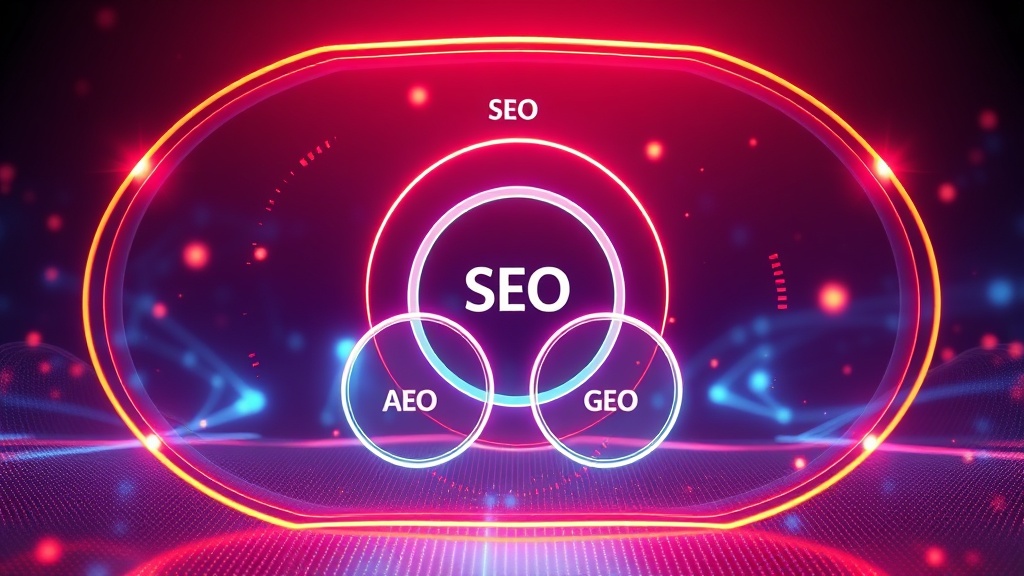
In today’s digital landscape, the convergence of SEO (Search Engine Optimization), AEO (Answer Engine Optimization), and GEO (Generative Engine Optimization) represents a dynamic shift in how content is discovered and ranked across search and AI platforms. Traditional SEO has long been the cornerstone of online visibility, focusing primarily on optimizing content to rank well in search engine result pages (SERPs) by targeting keywords, site architecture, and link-building. However, the rise of AI-powered search engines, voice assistants, and answer engines demands a broader strategy that not only targets organic traffic but also optimizes for AI-driven direct answers and generative search responses. This integration is no longer optional but essential for brands wanting to maintain and grow their digital presence.
Why is this triad so critical? Because search behavior is evolving rapidly. More users rely on AI assistants for quick, conversational answers rather than traditional links, and content is increasingly pulled into AI-generated responses that summarize information across the web. This means the way content is created, structured, and presented must satisfy both human readers and AI algorithms that use natural language processing to understand relevance and authority. Failure to adapt risks losing visibility to competitors who optimize better for these emerging search paradigms.
At the same time, the geographical context — known as GEO in one sense related to location-based SEO, but here specifically generative engine optimization relating to AI-driven content discovery — plays a pivotal role. It requires content designers to think semantically and strategically about how AI platforms interpret topics, brand authority, and citation across multiple AI systems simultaneously. This multifaceted optimization unlocks greater brand awareness not just through traditional search engines like Google, but also in AI chatbots, answer boxes, and voice searches.
This evolution raises significant questions: How does one craft content that ranks well traditionally while also being favored by AI-generated answers and voice assistants? How can the structural and technical groundwork support seamless indexing across these platforms? What strategies ensure your brand is identified as a trusted source that AI will cite? Navigating this complex environment demands a comprehensive understanding of SEO, AEO, and GEO’s unique but overlapping requirements.
The challenge extends beyond keywords and backlinks. It involves mastering user intent on a granular level, crafting content that anticipates questions and delivers concise, authoritative answers, using schema markup strategically to define content context for machines, and maintaining technical excellence in site speed, mobile usability, and crawlability. Moreover, it calls for building real-world expertise and demonstrating trustworthiness through digital PR and author credentials to appeal to AI’s growing emphasis on experience and authority signals.
In the following sections, we will delve into how to align content creation with user intent across these three optimization frameworks, implement structural strategies such as schema and content organization, address technical considerations for AI and traditional crawlers, integrate geographic and semantic relevance to maximize visibility, and explore emerging trends that will shape the future of digital content optimization. Whether you are managing a personal blog, a business website, or an enterprise platform, these insights will equip you to optimize a single blog post—not just for search engines alone but for the new wave of AI-driven discovery and interaction.
Aligning Content With User Intent for SEO, AEO, and GEO
Meeting user intent effectively is the cornerstone of optimizing any blog post for SEO, AEO, and GEO simultaneously. While SEO traditionally focuses on keyword intent—what the user is searching for—AEO expands this perspective by emphasizing direct answers and voice-friendly formats. GEO takes this further by ensuring content can be semantically understood and cited by generative AI across many platforms.
Start by conducting comprehensive research to uncover not just the keywords but the underlying questions and problems users seek to resolve. Tools that provide insight into common queries, such as “People Also Ask,” question analyzers, and search intent clusters, reveal the content structures AI and answer engines favor. This enables you to tailor the blog post around specific questions, ensuring you provide clear, concise answers upfront—typically in 40 to 60 words—ideal for featured snippets and voice responses.
Beyond question-focused content, intent alignment encourages a layered content strategy. For example, an overview section satisfies broad informational intent, while deeper sections or FAQs address niche or transactional queries. This layered approach aligns with how generative AI extracts and assembles information from different parts of a page to construct coherent responses.
Integrating semantic keywords and related concepts naturally throughout the article enriches GEO by signaling to AI models the depth and breadth of your topic expertise. This conversational tone also aligns well with voice search, where queries are often longer and more natural in phrasing. Maintaining topical authority by linking to well-regarded sources, showing firsthand experience, and incorporating data or case studies further builds trust and credibility, which are critical in AEO and GEO contexts.
Using Structured Data to Enhance Machine Understanding
Structured data, or schema markup, is one of the most powerful technical tools available for optimizing content at the intersection of SEO, AEO, and GEO. It translates human-readable content into clearly defined, machine-readable formats that enable search engines and AI to parse and present your content more effectively.
Several schema types serve different purposes:
- FAQPage schema helps content appear in answer boxes and voice assistants by clearly labeling question-and-answer pairs.
- HowTo schema enhances step-by-step guides, making them attractive for rich results and voice-guided instructions.
- Article schema provides context about the blog post’s structure, author, publisher, and publish date, strengthening E-E-A-T signals for both search engines and AI.
Implementing schema effectively requires precision; excessive or incorrect markup can confuse AI systems or trigger penalties. Additionally, prefer schema types that major search engines and AI platforms support to maximize cross-platform effectiveness. Testing your markup with tools like Google’s Rich Results Test or schema validators ensures correct implementation.
Structured data also assists GEO efforts by making content easier to extract for AI-driven generative responses. Since these models pull from multiple sources at once, properly marked-up content stands a higher chance of being cited as a trusted source. This enhances brand visibility and can drive direct traffic from AI discovery features.
Technical Foundations for Cross-Platform Indexing and Citation
Even the best content struggles if AI engines and search crawlers cannot access or correctly interpret your blog post. Technical optimization is thus essential to secure visibility across SEO, AEO, and GEO channels.
Key considerations include ensuring your site is crawlable with no inadvertent blocking via robots.txt or meta tags. JavaScript-heavy content can hinder AI bots that struggle with client-side rendering; adopting server-side rendering or hybrid architectures improves accessibility. Site speed matters greatly, especially for AI’s evaluation of content freshness and user experience.
Mobile responsiveness and HTTPS security are now baseline requirements, reinforcing trust signals both for human users and AI. Core Web Vitals metrics, such as page load time and visual stability, also directly influence rankings and AI citation likelihood.
Metadata, including descriptive title tags and question-oriented meta descriptions, supports AEO by aligning with common query phrases. Clear internal linking and content hierarchy help AI models understand relationship structures within your content, optimizing how excerpts are extracted. Leveraging sitemaps and regular content audits ensure active indexing.
Addressing AI-Specific Crawling Challenges
AI language models currently face limitations indexing content rendered solely by JavaScript, necessitating alternate rendering strategies such as server-side rendering. This approach pre-generates the full HTML content, making it immediately indexable by crawlers and AI systems. Additionally, emerging protocols like LLM.txt, though unofficial, may influence AI crawling behaviors and should be monitored.
Setting up optimized robots.txt files ensures AI crawlers can access all relevant content, avoiding accidental exclusion of important pages. Continuous monitoring of logs and crawling reports can identify indexing issues early, enabling rapid remediation to maintain visibility across generative AI platforms.
Incorporating Geographic and Semantic Relevance for GEO
Though GEO primarily refers to generative engine optimization, incorporating geographic and semantic relevance remains a powerful tactic to increase discovery by AI engines and local search mechanisms simultaneously. Geographic signals enhance relevance for location-specific queries, which AI assistants increasingly prioritize when delivering contextual responses.
Embedding local identifiers such as city names, state or country within content naturally but strategically allows generative models to connect your blog post to relevant local search intents. For instance, including regional jargon or referencing local landmarks signals context to AI and human readers alike, amplifying authoritative positioning in geo-targeted results.
Semantic optimization focuses on aligning content with how AI interprets language — emphasizing topic clusters, synonyms, and concept relationships rather than mere keyword density. This encourages AI to cite your blog post as a comprehensive resource. Employing topic modeling tools can assist in identifying relevant subtopics that complement primary themes.
Strategies for Combining GEO with Local SEO
Local SEO tactics such as optimizing Google Business Profiles, embedding NAP (Name, Address, Phone Number) details, and gaining citations on authoritative local directories feed into the GEO framework by enhancing brand authority within geographic contexts. When combined with semantic content clusters and structured data, these practices maximize your chances of appearing in AI-generated localized answers and voice search results.
Moreover, encouraging and showcasing real customer reviews and testimonials further boosts trusted signals, an essential aspect as AI increasingly values authentic, experience-driven content. A comprehensive geo-semantic approach ensures your single blog post is positioned not only as a global authority but also as a go-to local resource when relevant.
Next-Generation Optimization: Preparing for the AI-Driven Search Future
As AI technologies continue to evolve, the intersection of SEO, AEO, and GEO will become even more integrated and complex. Forward-looking content creators must embrace continuous learning and experimentation with new formats, algorithms, and user behaviors to maintain an edge.
One emerging trend is the growing importance of real-time data and content freshness, as AI favors up-to-date and accurate information. This signals a need to maintain content calendars that allow regular updates and expansions to existing posts. Leveraging AI tools to analyze user interaction patterns and identify evolving intent can guide iterative improvements, creating content that stays relevant across multiple discovery channels.
Additionally, the rise of multimodal AI systems combining text, audio, and video means that blog posts optimized for SEO, AEO, and GEO should incorporate diverse media types strategically. This increases accessibility and engagement, boosting both human and AI metrics of value.
Looking ahead, collaboration between human expertise and AI content creation is likely to deepen. While AI assists in scaling production and identifying gaps, human insight remains crucial in delivering nuanced, authoritative content that AI trusts and prefers to cite. Building a recognizable brand voice and demonstrating authentic experience will remain irreplaceable pillars of digital success.
Ultimately, optimizing a single blog post across SEO, AEO, and GEO is not merely about ticking technical boxes but about embracing a holistic content strategy tailored to today’s hybrid search ecosystem — one that rewards clarity, authority, semantic richness, and user-centric focus. Those who adapt early will find their content resonating not only across traditional search engines but also within the conversations of tomorrow’s AI-powered discovery platforms.