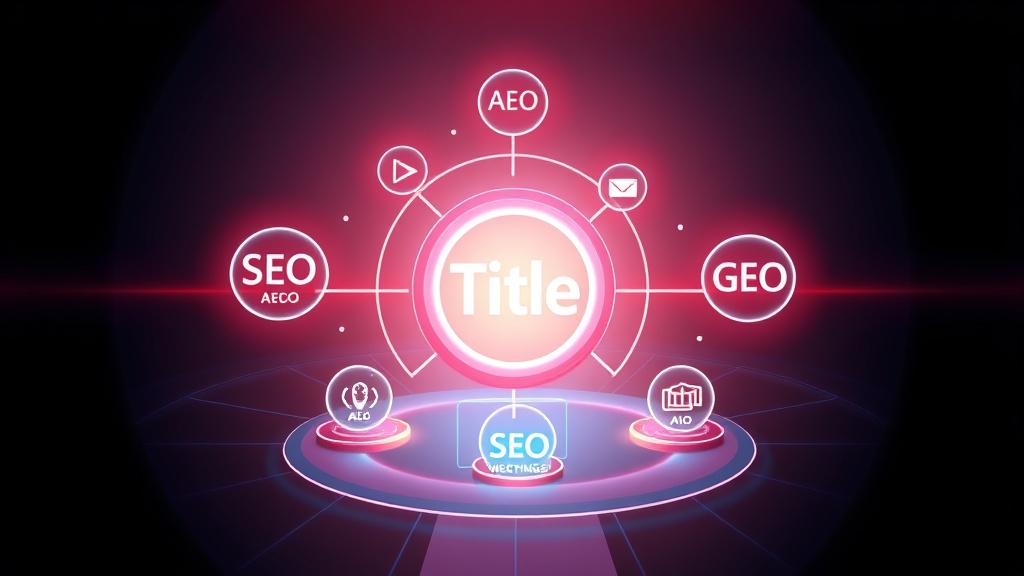
In the vast and ever-expanding digital landscape, where billions of pieces of content vie for attention daily, the unassuming title stands as the singular most critical gateway. Far from being a mere label, a well-crafted title is a potent strategic asset, a sophisticated fusion of art and science that dictates visibility, drives engagement, and ultimately determines the success of any digital content. This isn’t just about catching an eye; it’s about signaling relevance to complex algorithms, answering direct user queries, establishing local authority, and ensuring machine readability across an interconnected ecosystem. Understanding and mastering the nuanced interplay between SEO, AEO, GEO, and AIO in title creation is no longer optional—it is imperative for digital domination.
The Foundational Role of a Title in Digital Strategy
A title serves as the primary gateway to content, a critical signal for search algorithms and human users, encapsulating the content’s essence and influencing click-through rates and overall digital performance.
At its core, a title is the first point of contact between your content and your audience, whether that audience is a human user scrolling through search results or an artificial intelligence agent parsing data. It distills the entire content piece into a concise, compelling phrase, acting as a micro-summary and a powerful call to action. Its strategic importance permeates every layer of digital interaction, from initial discovery on a search engine results page (SERP) to shareability across social media platforms. A weak or irrelevant title can render even the most insightful content invisible, highlighting its foundational role in the overall content lifecycle and digital marketing funnel.
Beyond Mere Labeling: The Multilayered Function of a Title
The function of a title extends far beyond simple identification. It performs several critical roles simultaneously. Firstly, it provides an immediate first impression, setting expectations and communicating the content’s value proposition. Secondly, it acts as a content summarizer, giving users a snapshot of what to expect, which is crucial for decision-making in a high-information environment. Thirdly, and increasingly importantly, titles play a pivotal role in query matching, enabling search engines and AI systems to accurately align user intent with relevant information. This multifaceted utility underscores why title optimization is a continuous, analytical process.
SEO-Driven Titles: Maximizing Organic Visibility
SEO-driven titles are optimized to include primary keywords, demonstrate relevance to search queries, and adhere to character limits, signaling content authority and improving organic search rankings.
For decades, search engine optimization (SEO) has been the cornerstone of digital visibility, and titles remain a central pillar of any effective SEO strategy. A title’s direct influence on search engine ranking algorithms cannot be overstated. Search engines like Google utilize sophisticated indexing and ranking systems that heavily weigh the words used in a title to determine the content’s primary topic and relevance to specific search queries. Properly optimized titles can significantly enhance organic search performance, driving higher click-through rates (CTR) and ultimately, greater traffic.
Keyword Integration and Search Intent Alignment
Effective SEO titles meticulously integrate primary and secondary keywords that reflect user search intent. Tools like Google Keyword Planner, SEMrush, and Ahrefs are indispensable for identifying high-volume, relevant keywords and understanding the nuances of how users phrase their queries. Beyond direct keyword stuffing, modern SEO emphasizes semantic search and understanding the underlying intent behind a user’s query. Titles should not only contain keywords but also convey that the content directly answers a specific user need, whether it’s informational, navigational, commercial, or transactional. Utilizing long-tail keywords can also target niche audiences with higher conversion potential.
Technical Constraints and Best Practices for Search Engines
Technical considerations are paramount for SEO titles. Google’s SERP typically displays titles within a certain pixel width, which translates to approximately 50-60 characters before truncation. Exceeding this limit can lead to important keywords or value propositions being cut off, diminishing user experience and clickability. It is critical to differentiate between the meta title (HTML title tag) and the H1 heading tag. While often similar, the meta title is what appears in browser tabs and SERPs, while the H1 is the main on-page heading. Both should be optimized, but serve slightly different functions. Each page must also have a unique title to prevent duplicate content issues and ensure clear indexing by search engine crawlers.
AEO-Optimized Titles: Capturing Voice Search and AI Engagement
AEO-optimized titles are phrased naturally, often in question format or conversational tone, to match voice search queries and provide direct answers, catering to AI assistants and featured snippets.
As artificial intelligence (AI) assistants like Google Assistant, Amazon Alexa, and Apple Siri become ubiquitous, ‘Answer Engine Optimization’ (AEO) has emerged as a critical discipline. AEO focuses on optimizing content, including titles, to provide direct, concise answers to user queries, particularly those originating from voice search. These queries are typically more conversational and natural language-based than traditional text searches. Titles that anticipate and fulfill these conversational patterns are vital for securing featured snippets and direct answers, which dominate zero-click searches.
Conversational Language and Question-Based Phrasing
To excel in AEO, titles should embrace natural language processing (NLP) principles. This often means formulating titles as direct questions (e.g., ‘What is the best way to optimize a title?’) or as clear, declarative statements that answer a common question (e.g., ‘The Best Ways to Optimize Your Digital Titles’). Understanding the specific intent behind natural language queries is crucial. Users often phrase queries as ‘how to,’ ‘what is,’ ‘when to,’ or ‘where can I.’ Incorporating these phrases into titles, where appropriate, can significantly improve the chances of being identified as a relevant answer by AI systems and appearing in featured snippets.
Featured Snippets and Direct Answer Prominence
Featured snippets, also known as ‘position zero,’ are highly coveted as they offer maximum visibility. AEO-optimized titles play a direct role in capturing these snippets. If a title directly asks or answers a question, it signals to search engines that the content is a strong candidate for a direct answer. Beyond the title, the content immediately following it should provide a concise, definitive answer that can be easily extracted. This strategy not only benefits voice search but also enhances visibility for traditional text searches where users seek quick, definitive answers.
GEO-Strategic Titles: Local Relevance and Geographic Authority
GEO-strategic titles incorporate location-specific keywords, local landmarks, or service areas to attract geographically targeted audiences and establish relevance for localized search queries, enhancing local SEO efforts.
For businesses with a physical presence or those serving specific geographic regions, ‘Geographic Engine Optimization’ (GEO) is indispensable. GEO-strategic titles are designed to attract local audiences by explicitly incorporating location-based keywords. This is particularly vital for ‘near me’ searches, where users are looking for services or products within their immediate vicinity. By signaling local relevance through titles, businesses can capture high-intent local traffic and establish authority within their defined service areas.
Incorporating Local Modifiers and Geographic Entities
Effective GEO titles include precise geographic modifiers such as city names, neighborhoods, regions, or even specific landmarks. For example, ‘Best Coffee Shops in Brooklyn Heights’ or ‘Emergency Plumber Services in Downtown Seattle.’ It’s crucial to use the names of locations as users would naturally search for them. Beyond just city names, consider including phrases like ‘near me’ or ‘local [service]’ if the content is broadly applicable to local searches, or even specific zip codes or postal codes for highly localized targeting. This specificity helps algorithms connect user queries with the most geographically relevant results.
Google Business Profile and Local Pack Synergy
GEO-strategic titles work in synergy with other local SEO efforts, most notably a well-optimized Google Business Profile. While the title is for your web page, the information presented in your title should be consistent with your Google Business Profile listing, including your business name, address, and phone number (NAP consistency). This coherence reinforces your local authority and trustworthiness. When a user performs a local search, Google often displays a ‘local pack’ – a map and three business listings. Having GEO-optimized titles can help your pages rank well, complementing your Google Business Profile to secure a prominent spot in these crucial local search results.
AIO-Enhanced Titles: Machine Readability and Cross-Platform Adaptability
AIO-enhanced titles are structured for machine readability, often employing clear, concise language and consistent formatting, ensuring seamless content parsing and accurate interpretation across diverse AI platforms and content aggregators.
The broader concept of ‘Artificial Intelligence Optimization’ (AIO) extends beyond just conversational AI to encompass how all forms of AI, machine learning algorithms, and automated systems process and understand digital content. AIO-enhanced titles are crafted with machine readability in mind, ensuring that bots, aggregators, and future AI systems can accurately parse, categorize, and interpret the content’s core subject matter. This involves clear, unambiguous language, consistent terminology, and a logical structure that facilitates automated understanding across various digital touchpoints and platforms.
Clarity, Conciseness, and Semantic Structure
For optimal AIO, titles must be unequivocally clear and concise, avoiding jargon, ambiguity, or overly clever phrasing that might confuse an algorithm. Every word should contribute to the title’s meaning. The semantic structure should be straightforward, making it easy for AI models, many of which rely on transformer architectures, to identify the main entities and concepts. For example, a title like ‘Comprehensive Guide to Digital Marketing Metrics’ is more machine-readable than ‘Unlocking Your Marketing DNA: A Data Journey.’ Using strong, descriptive nouns and verbs helps to create a robust semantic fingerprint for the content.
Schema Markup and Structured Data for Title Context
While schema markup is not directly embedded within the title itself, it provides crucial context that augments an AI’s understanding of the title’s content and intent. By using schema.org vocabulary like Article, BlogPosting, or Product, you can explicitly tell search engines and AI systems what your content is about, enhancing the interpretation of your title. For instance, if your title is ‘Best Smartphones of 2024,’ rich snippets enabled by schema markup can display star ratings, price ranges, or availability directly on the SERP, making the title even more compelling and machine-understandable for specific AI applications that process structured data.
The Synergy of Optimization: A Holistic Title Strategy
A holistic title strategy integrates elements of SEO, AEO, GEO, and AIO, balancing keyword density with conversational phrasing, local relevance, and machine readability to create titles that perform optimally across all digital channels.
In today’s complex digital ecosystem, optimizing a title for just one aspect—be it SEO, AEO, GEO, or AIO—is insufficient. A truly effective title strategy demands a holistic approach, where elements from each optimization discipline are thoughtfully integrated. The goal is to craft titles that are not only algorithmically friendly but also resonate with human users, regardless of how they access or discover the content. This synergy ensures maximum reach, engagement, and conversion across the fragmented digital landscape.
Balancing Competing Optimization Demands
Often, the demands of different optimization types can seem to conflict. An SEO-heavy title might be keyword-rich but less conversational for AEO. A GEO-specific title might narrow the audience, while AIO requires broad clarity. The challenge lies in finding the optimal balance. This might involve front-loading important keywords for SEO and then adding a conversational element. For instance, ‘Best Pizza in Naples, FL: A Local’s Guide’ combines GEO and SEO, while being relatively natural. It’s about prioritizing the most critical optimization factor for a given piece of content, while still incorporating secondary factors where possible, making strategic trade-offs.
Iterative Testing and Performance Monitoring
A holistic title strategy is not a one-time setup; it’s an ongoing, iterative process. A/B testing different title variations is crucial to understand what resonates best with your target audience and performs strongest across various search and AI platforms. Monitor key performance indicators (KPIs) such as click-through rates (CTR), dwell time, bounce rate, and conversion rates. Utilize analytics platforms like Google Analytics and Google Search Console to gain insights into how your titles are performing in search. Continuous refinement based on data-driven insights ensures that your titles remain effective and adaptable to evolving algorithmic changes and user behaviors.
Crafting the Perfect Title: A Practical Framework
Crafting the perfect title involves understanding your audience, identifying core keywords, incorporating emotional triggers, ensuring clarity and conciseness, and continuously testing its effectiveness against defined performance metrics.
Moving from theory to practice, creating an impactful title requires a structured approach. It begins with a deep understanding of your target audience and their needs, extends through rigorous keyword research, and culminates in the artful construction of a compelling headline. This framework ensures that your titles are not only technically optimized but also creatively engaging, maximizing their potential to attract and convert.
Understanding Your Audience and Search Intent
Before writing a single word, thoroughly understand who you are trying to reach and what problem your content solves for them. What questions are they asking? What pain points do they have? What language do they use? This foundational understanding of audience persona and search intent will guide your keyword selection and help you frame your title in a way that directly speaks to their needs and desires. Empathy is a powerful tool in title crafting.
Utilizing Tools for Keyword Research and Analysis
Leverage advanced keyword research tools to identify high-volume, relevant keywords, understand semantic relationships, and discover long-tail opportunities. Tools like Semrush, Ahrefs, Moz Keyword Explorer, and Google’s own Keyword Planner are invaluable. Look beyond obvious terms; explore related questions, competitor analysis, and audience forums to unearth niche keywords that your audience is actively searching for. Analyze search volume, keyword difficulty, and intent for each candidate keyword.
The Art of the Hook: Emotion, Curiosity, and Value Proposition
Beyond keywords and technical parameters, a great title possesses a ‘hook’ that compels a click. This involves weaving in emotional triggers, fostering curiosity, or clearly stating a strong value proposition. Power words (e.g., ‘ultimate,’ ‘secret,’ ‘proven,’ ‘essential’) can amplify impact. Numbers (e.g., ’10 Ways to…’) often perform well. The title should clearly communicate ‘What’s In It For Me?’ to the user, promising a solution, benefit, or engaging experience that distinguishes it from competing titles on the SERP.
| Optimization Type | Primary Objective | Key Title Characteristics | Example Title |
|---|---|---|---|
| SEO | Organic Search Ranking, CTR | Keywords, topic relevance, character limits | ‘Advanced SEO Techniques for Digital Marketing’ |
| AEO | Voice Search, Featured Snippets | Conversational tone, question format, direct answers | ‘How Does Voice Search Optimization Work?’ |
| GEO | Local Search, Geographic Relevance | Location-specific keywords, service area focus | ‘Best Italian Restaurants in Downtown Austin’ |
| AIO | Machine Readability, AI Comprehension | Clarity, conciseness, semantic structure | ‘Blockchain Technology Explained: A Comprehensive Overview’ |
The title is no longer just a headline; it is a meticulously crafted digital asset that operates at the nexus of human psychology and algorithmic logic. Its power lies in its ability to simultaneously communicate with diverse audiences—from casual browsers to sophisticated AI systems. By strategically integrating the principles of SEO, AEO, GEO, and AIO, content creators and strategists can unlock unparalleled visibility, engagement, and authority in the competitive digital realm. Mastering the art and science of title creation is not merely an optimization tactic; it is a fundamental pillar of modern digital success, demanding continuous attention, innovation, and data-driven refinement.