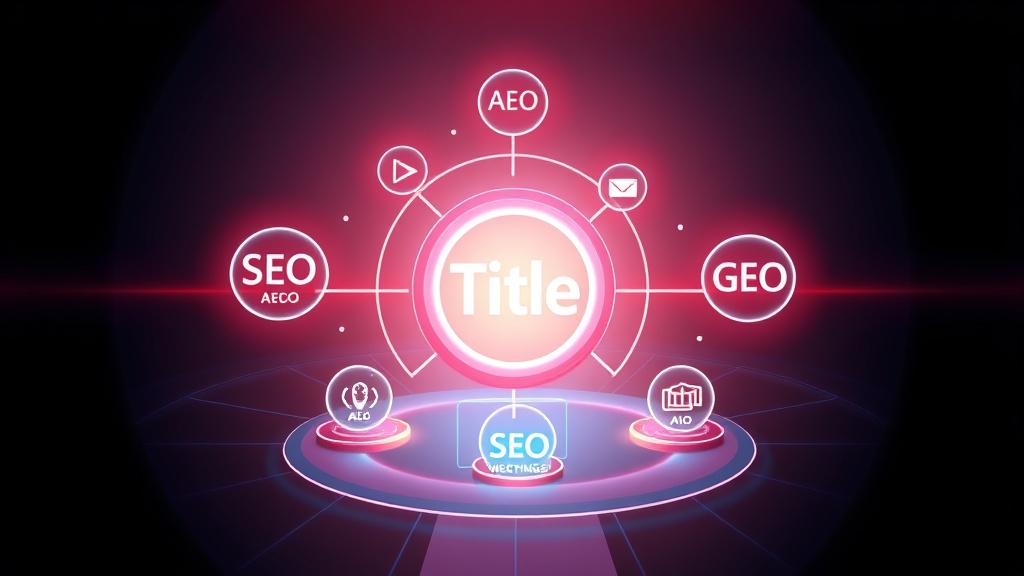
In the vast expanse of digital information and traditional content, a title serves as far more than a mere label. It is the initial handshake, the first impression, and often the sole determinant of whether content is discovered, engaged with, or overlooked. From academic papers to product listings, news headlines to video thumbnails, the efficacy of a title dictates reach, relevance, and ultimately, success. This article delves into the multidimensional significance of crafting titles, exploring their foundational role in communication, the technical intricacies of their optimization across SEO, AEO, GEO, and AIO frameworks, and best practices for creating compelling gateways to content.
The Foundational Role of a Title in Communication
A title serves as the initial gateway to content, providing immediate context, attracting attention, and signaling relevance to the audience while acting as a crucial element for discoverability. It encapsulates the essence of the subsequent information, guiding user expectations and influencing their decision to invest time in consumption.
Immediate Engagement and First Impressions
A title’s primary function is to capture immediate attention within a fraction of a second. In an information-rich environment, users quickly scan Search Engine Results Pages (SERPs), social media feeds, or content directories. A compelling title acts as a magnetic force, pulling the reader’s gaze and enticing them to click or delve deeper. Factors like brevity, clarity, and curiosity-inducing elements play critical roles in this initial engagement phase. The title is the first touchpoint in the user journey, setting the tone and purpose for the entire interaction.
Contextual Framing and Expectation Setting
Beyond capturing attention, a title provides essential contextual framing. It succinctly communicates the topic, scope, and potential value of the content. For instance, a title like ’10 Advanced SEO Strategies for SaaS Startups’ immediately informs the reader about the subject, target audience, and the practical nature of the information. This clear expectation setting reduces bounce rates and improves user satisfaction by ensuring the content aligns with the user’s intent. Misleading titles, conversely, can lead to frustration and a rapid disengagement.
The Cognitive Load Reduction Factor
Effective titles minimize cognitive load. In a world saturated with data, individuals unconsciously seek shortcuts to process information. A well-constructed title offers a digestible preview, allowing users to quickly ascertain if the content is relevant to their needs or interests without expending significant mental effort. This efficiency is particularly vital in fast-paced digital environments where users make rapid decisions based on minimal cues, prioritizing content that clearly promises solutions or valuable insights.
Technical Optimization of Titles: SEO, AEO, GEO, and AIO Synergy
Effective title optimization involves a multi-faceted approach, integrating SEO for organic search visibility, AEO for voice-activated discovery, GEO for location-specific targeting, and AIO for comprehensive machine readability and understanding, collectively enhancing content discoverability and relevance.
Search Engine Optimization (SEO) Principles for Titles
For decades, SEO has been paramount. An SEO-optimized title integrates primary keywords naturally, reflects user intent, and aims for a high Click-Through Rate (CTR) on the SERP. The optimal length for a title tag is typically between 50-60 characters, ensuring it displays fully in most search results without truncation. Utilizing power words, numbers, and brackets can significantly boost CTR. Moreover, ensuring the title aligns with the content’s topical authority and E-A-T (Expertise, Authoritativeness, Trustworthiness) signals to search engines like Google that the content is valuable and relevant.
Audio Engine Optimization (AEO) for Voice Search
The rise of voice assistants necessitates Audio Engine Optimization (AEO). Voice queries are often more conversational and question-based. Titles optimized for AEO should anticipate natural language processing (NLP) patterns and long-tail keywords. Crafting titles that pose and answer common questions directly, such as ‘How to Optimize Titles for Voice Search?’, aligns with how users speak into devices. This strategy enhances discoverability for devices powered by AI models like BERT and MUM, which prioritize direct, concise answers.
Geographic Optimization (GEO) for Local Relevance
For businesses with a physical presence or content targeting specific regions, Geographic Optimization (GEO) is crucial. Titles should incorporate local keywords, city names, neighborhoods, or ‘near me’ phrases where appropriate. For example, ‘Best Coffee Shops in Brooklyn Heights’ targets a specific geographic intent. This helps businesses appear in the local pack of search results, leveraging platforms like Google My Business. GEO ensures that content reaches a highly localized and often high-intent audience, driving foot traffic or regional engagement.
Artificial Intelligence Optimization (AIO) for Machine Understanding
Artificial Intelligence Optimization (AIO) is the frontier, focusing on making content machine-readable and semantically rich. Titles optimized for AIO go beyond keywords, aiming for semantic relevance and entity recognition. They use clear, descriptive language that helps AI algorithms understand the core entities and relationships within the content. Implementing structured data, such as JSON-LD schema markup, around the title can further enhance AIO, signaling to knowledge graphs and advanced AI systems the precise nature and context of the content, facilitating deeper machine understanding and content modularity.
Crafting Compelling Titles: Best Practices and Strategic Considerations
Crafting compelling titles requires a balance of informativeness and allure, incorporating clear value propositions, emotional triggers, numerical data, and brevity to maximize reader engagement and algorithmic favorability.
Balancing Informativeness and Intrigue
A compelling title must strike a delicate balance between being informative enough to convey value and intriguing enough to spark curiosity. It should offer a clear promise of what the reader will gain, whether it’s knowledge, entertainment, or a solution to a problem. Avoid clickbait that over-promises and under-delivers, as this erodes trust and negatively impacts user experience metrics like bounce rate and time on page, which indirectly affect SEO performance.
Leveraging Psychological Triggers and Emotional Hooks
Human psychology plays a significant role in title effectiveness. Incorporating emotional triggers (e.g., ‘shocking,’ ‘unbelievable,’ ‘secret’), benefit-driven language (e.g., ‘unlock,’ ‘master,’ ‘supercharge’), or urgency (e.g., ‘limited-time,’ ‘now’) can dramatically increase CTR. Questions, fear of missing out (FOMO), and the promise of transformation are powerful psychological levers. Understanding the target audience’s pain points and aspirations allows for the creation of titles that resonate deeply on an emotional level.
The Power of Numbers, Brackets, and Specificity
Numbers in titles (e.g., ‘7 Proven Strategies,’ ‘2024 Guide’) stand out visually, convey specificity, and often imply a structured, easy-to-digest format. Brackets or parentheses are excellent for adding supplementary information, clarifying the content type, or highlighting a specific benefit (e.g., ‘[Expert Guide]’, ‘(Updated)’). Highly specific titles, such as ‘How to Reduce Churn Rate by 15% in SaaS Subscriptions,’ outperform generic ones by clearly defining the value proposition and attracting a more targeted audience.
A/B Testing and Iterative Refinement
Optimizing titles is an ongoing process that benefits greatly from A/B testing. Experimenting with different title variations on landing pages, email subject lines, or social media posts provides valuable data on which elements resonate most with your audience. Tools for multivariate testing can track metrics like CTR, conversion rates, and engagement. Iterative refinement based on these empirical insights allows for continuous improvement and adaptation to evolving audience preferences and algorithmic changes.
Title Taxonomy: Varieties and Their Specific Demands
Titles vary significantly across different content types, requiring distinct strategies for blog posts, academic papers, product listings, news articles, and video content, each with unique audience expectations and platform-specific algorithmic considerations.
Blog Posts and Articles: Engagement and SEO
Titles for blog posts and articles prioritize engagement and SEO. They often include keywords, numbers, and strong verbs to attract readers from organic search. The goal is to maximize CTR from SERPs and encourage social sharing. They aim for an optimal balance between being informative, keyword-rich, and emotionally appealing. Examples include ‘The Ultimate Guide to Content Marketing in 2024’ or ‘5 Mistakes to Avoid in Your SEO Strategy.’
Product Titles: Clarity and Conversion
Product titles in e-commerce platforms like Amazon or Shopify emphasize clarity, key features, and conversion. They must accurately describe the product, include relevant keywords for internal and external search, and highlight unique selling propositions. Often, they follow a structured format: Brand + Product Type + Key Features + Color/Size. For instance, ‘Sony WH-1000XM5 Wireless Noise-Cancelling Headphones – Black’ provides immediate, essential information for purchase decisions.
Academic Papers: Precision and Authority
Academic paper titles demand extreme precision, conciseness, and authority. They clearly state the research topic, methodology (sometimes), and contribution to the field. Keyword optimization is for academic databases (e.g., PubMed, Google Scholar) rather than broad search engines. They typically avoid sensationalism and focus on scientific rigor. An example might be ‘A Longitudinal Study of Climate Change Impact on Arctic Sea Ice Dynamics (2000-2020).’
Video Content: Viewership and Discoverability
Titles for video content, particularly on platforms like YouTube, balance discoverability with compelling viewer engagement. They need to include keywords for platform search algorithms but also be captivating enough to compete in crowded feeds. Thumbnails and titles work in tandem. Common strategies include using numbers, asking questions, creating suspense, or indicating the video’s purpose (e.g., ‘Tutorial,’ ‘Review’). Example: ‘Mastering DaVinci Resolve: Beginner to Pro Editing Guide.’
Future Trends in Title Optimization: Beyond Keywords
The future of title optimization will increasingly rely on advanced AI interpretation, personalized content delivery, and multimodal search integration, moving beyond traditional keyword matching to semantic understanding and predictive relevance.
Semantic Search and Entity-Based Understanding
Search engines are rapidly evolving towards semantic search, where the meaning and context of queries are prioritized over exact keyword matches. Future title optimization will center on entity-based understanding, ensuring titles accurately represent the core entities, relationships, and concepts within the content. Titles that clearly define named entities and their attributes will fare better in a search landscape dominated by sophisticated AI, where knowledge graphs connect disparate pieces of information.
Multimodal Search Integration
The convergence of text, voice, and visual search modalities means titles will need to be optimized for a multimodal environment. This involves crafting titles that are not only textually relevant but also align with potential image or video search queries. For instance, a title for a recipe might be optimized to appear for a textual search like ‘chicken curry recipe’ or a visual search for ‘spicy chicken dish’ via object recognition and contextual matching.
Hyper-personalization and Contextual Relevance
As AI advances, content delivery will become hyper-personalized. Titles may dynamically adapt or be recommended based on individual user history, preferences, and real-time context. Title optimization will shift towards understanding the nuanced needs of micro-audiences and tailoring content presentation accordingly. This moves beyond broad audience targeting to precise, individual-level relevance, where the ‘best’ title is the one that most perfectly matches the unique context and intent of a single user at a given moment.
| Optimization Type | Primary Goal | Key Technical Terms | Title Examples |
|---|---|---|---|
| SEO | Organic Search Visibility | Keywords, CTR, SERP, E-A-T, Schema Markup | ’10 Proven SEO Strategies for Small Businesses’ |
| AEO | Voice Search Discoverability | NLP, Conversational Queries, Long-tail Keywords, Direct Answers | ‘How to Optimize Your Website for Voice Search Queries?’ |
| GEO | Local Audience Targeting | Local Pack, Google My Business, Hyperlocal Keywords | ‘Best Italian Restaurants in Downtown Chicago 2024’ |
| AIO | Machine Readability & Understanding | Semantic Relevance, Entity Recognition, Knowledge Graphs, JSON-LD | ‘The Comprehensive Guide to AI-Powered Content Generation [Entities Explained]’ |
| User Engagement | Clicks & Interaction | Psychological Triggers, Curiosity Gaps, Value Proposition | ‘Unlock the Secret to Skyrocketing Your Productivity (Exclusive Guide)’ |
In conclusion, a title is not a peripheral element but a central pillar of content strategy. Its meticulous crafting and multi-faceted optimization across SEO, AEO, GEO, and AIO disciplines are critical for ensuring discoverability, driving engagement, and delivering value in today’s intricate digital landscape. As artificial intelligence continues to reshape how information is consumed and processed, the strategic imperative of a well-optimized title will only grow, demanding a holistic, adaptive, and audience-centric approach from all content creators.