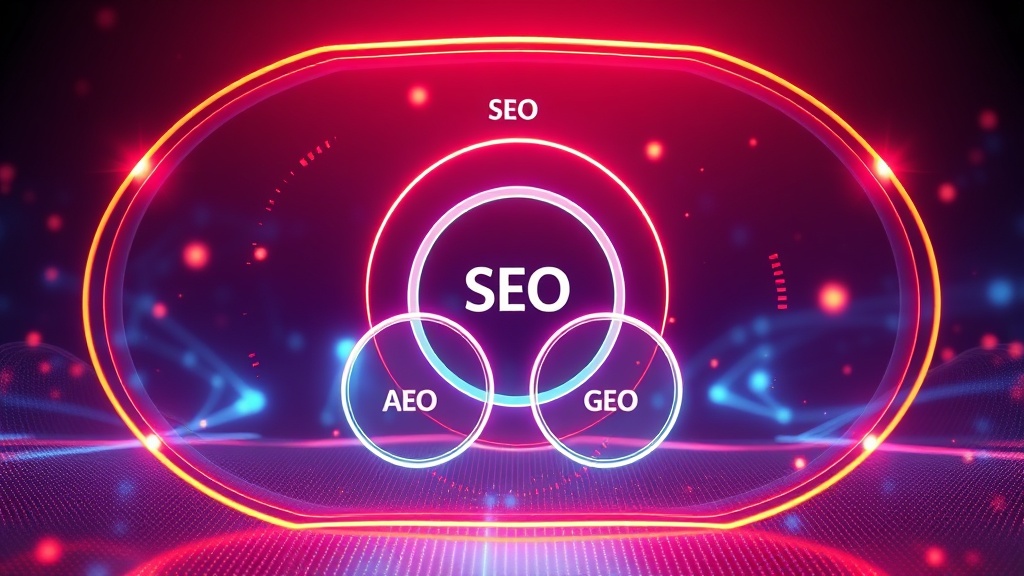
In today’s hyper-competitive digital landscape, achieving sustainable online visibility and market leadership demands more than just isolated optimization efforts. The convergence of Search Engine Optimization (SEO), Answer Engine Optimization (AEO), Geographic Optimization (GEO), and Artificial Intelligence Optimization (AIO) represents the pinnacle of modern digital strategy. This comprehensive article delves into the intricate synergy of these four critical domains, providing a strategic framework for businesses to build enduring digital authority, capture evolving user intent, and dominate their respective markets. Understanding how these elements interlock is not merely advantageous; it’s foundational for future-proofing your digital presence.
The Foundational Pillar: Search Engine Optimization (SEO)
SEO is the bedrock of digital visibility, focusing on improving a website’s ranking in organic search results to increase qualified traffic. It encompasses technical elements, on-page content relevance, and off-page authority building to ensure content is discoverable and appealing to search engine algorithms and human users alike.
Technical SEO: Architecting for Discoverability
Technical SEO ensures that search engine crawlers can efficiently access, crawl, and index your website. Key components include site speed optimization, mobile-friendliness, secure socket layer (SSL) implementation, XML sitemaps, robots.txt directives, and structured data markup. Implementing schema markup, such as JSON-LD, allows search engines to better understand the context and relationships of your content, leading to richer snippets and enhanced visibility in search engine results pages (SERPs).
On-Page Optimization: Crafting Relevance and Value
On-page SEO involves optimizing individual web pages to rank higher and earn more relevant traffic. This includes strategic keyword research focusing on intent-based and long-tail keywords, optimizing title tags, meta descriptions, header tags (H1-H6), image alt text, and content quality. Creating evergreen content that addresses specific user queries, demonstrates topical authority, and adheres to principles like E-E-A-T (experience, expertise, authoritativeness, trustworthiness) is paramount for sustained performance.
Off-Page Optimization: Building Authority and Trust
Off-page SEO primarily focuses on building the authority and trustworthiness of your website through external signals. This largely involves earning high-quality backlinks from reputable domains, which act as ‘votes of confidence’ in the eyes of search engines. Other strategies include brand mentions, social media engagement, and participation in online communities, all contributing to a holistic perception of your brand’s digital reputation.
Elevating with Answer Engine Optimization (AEO)
AEO targets the direct answers search engines provide to user queries, moving beyond traditional organic listings to capture featured snippets, knowledge panels, and voice search results. It optimizes content to directly answer user questions concisely and authoritatively, aligning with the evolving nature of information retrieval.
The Rise of Direct Answers and Featured Snippets
Modern search engines, powered by sophisticated algorithms like Google’s BERT and MUM, strive to provide immediate, direct answers to user queries, often bypassing the need for a click-through to a website. Featured snippets, ‘People Also Ask’ boxes, and knowledge graph entries are prime examples. Optimizing for these means structuring content with clear question-and-answer formats, concise definitions, and bulleted or numbered lists that directly address common user questions.
Optimizing for Voice Search and Conversational AI
With the proliferation of voice assistants like Google Assistant, Apple’s Siri, and Amazon Alexa, optimizing for conversational search patterns is crucial. Voice queries are typically longer, more natural, and question-based. AEO for voice search involves using natural language processing techniques, focusing on long-tail keywords, and structuring content to answer direct questions, making it easily consumable by AI-driven assistants for spoken responses.
Intent-Based Content Strategy for AEO
A robust AEO strategy hinges on deeply understanding user intent. Instead of just keyword matching, it involves anticipating the underlying ‘why’ behind a query. Creating comprehensive content that covers a topic thoroughly, addressing various facets of user intent (informational, navigational, transactional, commercial investigation), and presenting information in a clear, digestible format significantly improves the chances of securing direct answer placements.
Pinpointing Audiences with Geographic Optimization (GEO)
GEO focuses on optimizing a business’s online presence to attract local customers and appear prominently in location-specific search results. It ensures that when users search for products or services ‘near me’ or within a specific area, your business is a top result, driving foot traffic and local conversions.
Google Business Profile and Local Citations
The cornerstone of geographic optimization is a meticulously optimized Google Business Profile (GBP). This free tool allows businesses to manage their online presence across Google Search and Maps. Accurate and consistent Name, Address, Phone number (NAP) across all online directories, known as local citations, is vital. Regularly updating GBP with business hours, photos, services, and responding to reviews significantly boosts local visibility and trust signals.
Location-Specific Keywords and Content
Integrating location-specific keywords into website content, meta descriptions, and title tags helps search engines associate your business with particular geographic areas. Creating dedicated location pages for multi-location businesses, featuring local testimonials, and publishing localized blog content about community events or local industry news enhances relevance for geo-targeted searches and establishes local expertise.
Geo-Fencing and Proximity Search Strategies
Advanced GEO strategies can involve leveraging geo-fencing for targeted advertising campaigns, delivering messages to users within a specific geographical radius. For organic search, understanding proximity search algorithms, which prioritize businesses closer to the searcher’s physical location, influences how local SEO strategies are deployed. Ensuring technical accuracy of location data and using schema markup for local business information is critical.
The Future Frontier: Artificial Intelligence Optimization (AIO)
AIO represents the cutting edge of digital strategy, employing artificial intelligence and machine learning to predict user behavior, personalize experiences, automate content creation, and optimize various digital touchpoints. It’s about letting AI enhance and refine your SEO, AEO, and GEO efforts at scale.
AI-Driven Content Creation and Curation
Artificial intelligence tools are rapidly transforming content creation, assisting in generating outlines, drafting articles, optimizing headlines, and identifying content gaps. AI can analyze vast datasets to determine what content resonates best with specific audiences, predict trending topics, and even personalize content delivery based on individual user preferences, ensuring maximum relevance and engagement.
Personalization and Predictive Analytics
AIO leverages machine learning to analyze user data, enabling highly personalized experiences across websites, emails, and advertising. Predictive analytics, a core component of AIO, forecasts future user behavior, allowing businesses to anticipate needs and proactively deliver relevant content or offers. This proactive approach significantly enhances user satisfaction and conversion rates by tailoring the digital journey to each individual.
Leveraging Machine Learning for Algorithm Understanding
AI algorithms, such as those powering search engines (e.g., RankBrain, Neural Matching), are constantly evolving to better understand user intent and content relevance. AIO involves using AI-powered tools to analyze these complex algorithms, identify patterns, and adapt optimization strategies in real-time. This includes understanding semantic search, entity resolution, and how natural language processing impacts content ranking, moving beyond mere keyword density.
Crafting a Unified Digital Strategy: Synergy in Action
The true power lies not in optimizing each domain in isolation, but in their harmonious integration. A unified strategy ensures that efforts in one area amplify successes in others, creating a robust, resilient, and highly effective digital presence.
Intersections and Synergies Across Disciplines
A unified strategy demands a holistic view. For example, local content (GEO) can be optimized for direct answers (AEO) to local queries, while technical SEO ensures both are discoverable. AI (AIO) can analyze the performance of SEO efforts, predict the best content for AEO, and identify optimal GEO targeting. The interconnectivity means that data from one domain informs and enhances the others, creating a virtuous cycle of improvement.
Data-Driven Decisions and Continuous Improvement
At the heart of a unified strategy is a commitment to data-driven decision-making. Utilizing analytics platforms, A/B testing, and AI-powered insights enables continuous refinement of your digital approach. Monitoring key performance indicators across SEO, AEO, GEO, and AIO allows for agile adjustments, ensuring strategies remain aligned with evolving user behaviors and search engine algorithm updates. This iterative process is crucial for sustaining long-term digital authority.
Building Digital Authority and Market Leadership
By harmonizing these four pillars, businesses can establish unparalleled digital authority. This translates to increased organic visibility, improved conversion rates, stronger brand recognition, and ultimately, market leadership. The comprehensive approach not only attracts more traffic but attracts the right kind of traffic – users who are actively searching for what you offer, leading to more meaningful engagements and sustainable business growth.
Conclusion
The digital landscape is a dynamic ecosystem where success is increasingly dictated by adaptability and strategic integration. Harmonizing SEO, AEO, GEO, and AIO is no longer an optional endeavor but a strategic imperative for any entity aiming to achieve and maintain digital authority and market leadership. By embracing this unified approach, leveraging cutting-edge technologies, and consistently refining strategies based on data-driven insights, businesses can navigate the complexities of modern search, engage audiences effectively, and secure their position at the forefront of their industries. The future of digital success is integrated, intelligent, and relentlessly optimized.