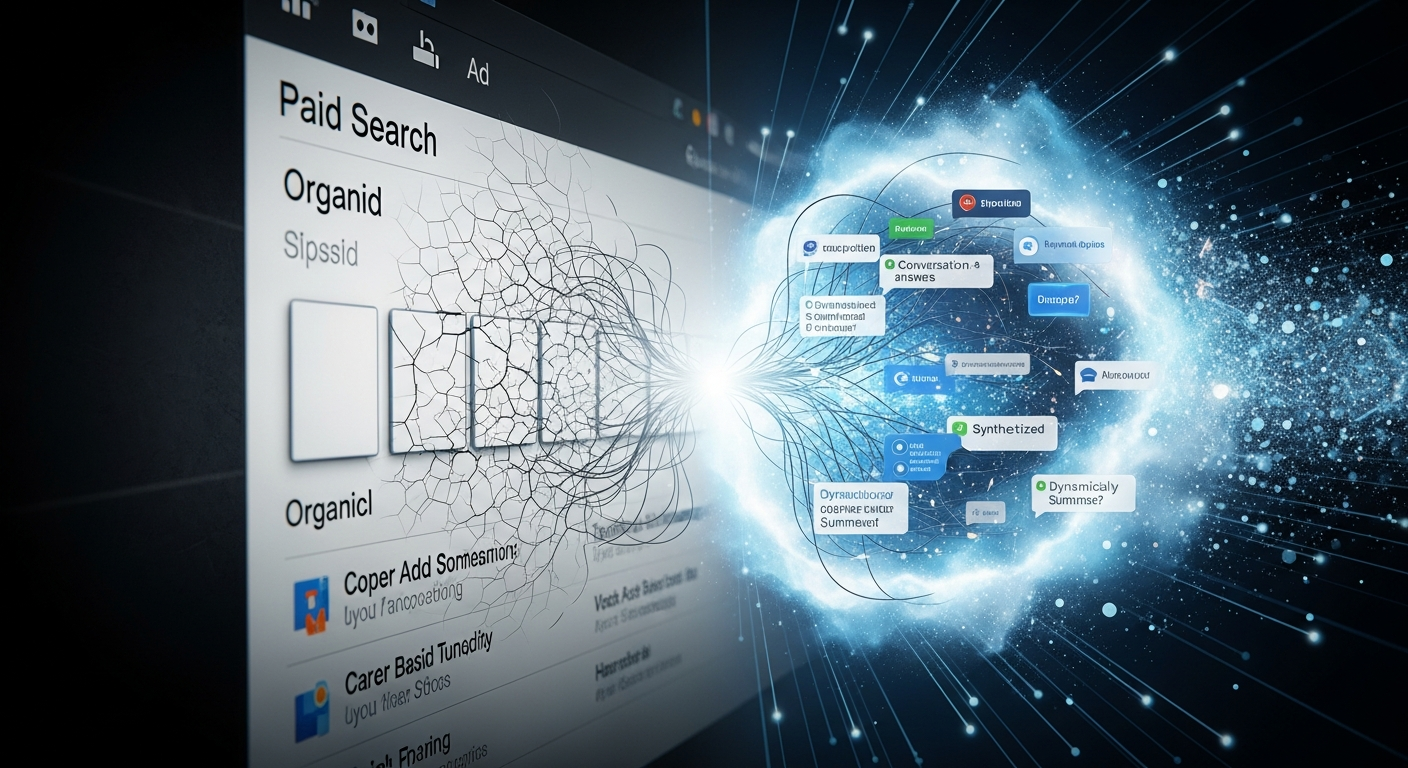
For over two decades, the world of digital marketing has revolved around a predictable, powerful engine: paid search. Entrepreneurs and marketers built empires on the simple premise that user intent, expressed through a keyword typed into a search box, was the most valuable signal on the internet. Bidding on that intent placed a brand at the precise moment a customer was ready to research, compare, or buy. This reliable ecosystem, dominated by Google Ads, created a multi-billion dollar industry and became a foundational pillar of modern business growth. But the ground beneath this pillar is shaking, and the tremors are emanating from the rapid rise of generative artificial intelligence. The familiar search engine results page—the reliable list of ten blue links topped by a few sponsored ads—is facing an existential threat. A paradigm shift is underway, moving us from an era of searching for links to one of receiving synthesized, conversational answers.
This transformation is most visible in features like Google’s AI Overviews (formerly Search Generative Experience, or SGE), which present a single, AI-generated summary at the very top of the results page. Instead of clicking through multiple websites to piece together information, users now receive a comprehensive, albeit machine-generated, answer directly. This fundamental change in user experience strikes at the heart of the paid search model. If users get their questions answered without needing to click on ads—or if those ads are pushed far below a large AI-generated block of text—what happens to click-through rates, traffic, and ultimately, return on ad spend? Early data already paints a concerning picture, with some studies showing significant drops in click-through rates for both organic and paid results when an AI overview is present. The rise of these “zero-click searches” is accelerating, forcing a difficult question: will the dependable engine of paid search sputter and stall?
This isn’t just a minor algorithmic tweak; it’s a complete reimagining of how information is delivered and consumed. The implications for businesses are profound. The strategies that guaranteed visibility and growth for years may soon become obsolete. For entrepreneurs and marketers who have honed their skills in keyword research, bidding strategies, and ad copy optimization, this new landscape can feel disorienting and threatening. However, to view this shift merely as a threat is to miss the larger picture. While the traditional playbook for paid search is being rewritten, new opportunities are emerging within the generative AI framework itself. The death of paid search is not a foregone conclusion; rather, we are witnessing a forced, rapid evolution. Survival—and indeed, success—will depend on understanding the mechanics of this new world and adapting with speed and strategic foresight. It requires moving beyond a keyword-centric mindset to embrace a more holistic view of user journeys, data integration, and brand authority in an AI-driven ecosystem.
The Unsettling New Search Landscape
The core disruption of generative search lies in its fundamental alteration of user behavior and the very structure of the search engine results page (SERP). For years, the digital marketing world was built on a stable foundation: users scanned a list of options and clicked. Paid search thrived by securing the top positions in that list, guaranteeing visibility at the moment of highest intent. Generative AI shatters that model by inserting a powerful new intermediary—the AI-generated overview. This single, consolidated answer, positioned at the very top of the page, often takes up significant screen real estate, especially on mobile devices. Consequently, the paid ads that once held the most coveted digital turf are frequently pushed down, sometimes significantly “below the fold.” This displacement alone is enough to cause alarm, as it directly impacts ad visibility and the likelihood of engagement. Data from early studies on AI Overviews confirms these fears, showing a marked decline in click-through rates for paid ads when an AI summary is present. Users, particularly those with informational queries, find their needs met by the AI’s answer and feel little compulsion to scroll further to engage with sponsored links.
This phenomenon is accelerating the trend of “zero-click searches,” where a user’s entire journey is contained within the SERP. While zero-click searches existed before generative AI—through featured snippets and knowledge panels—the comprehensive and conversational nature of AI Overviews makes them far more powerful and all-encompassing. Some projections suggest that the percentage of searches ending without a click to an external website could rise dramatically, posing a direct threat to business models that rely on driving traffic from search engines. This creates a new, intense level of competition for a shrinking pool of clicks. As the volume of available clicks decreases, the cost-per-click (CPC) for high-intent keywords is expected to rise, putting pressure on marketing budgets and challenging the profitability of long-standing campaigns. The predictable auction dynamics that advertisers have mastered are becoming more volatile and less transparent, forcing a difficult re-evaluation of paid search as a reliable channel for customer acquisition.
Rethinking The Ad Itself: New Formats And Integrations
As the traditional SERP dissolves, the nature of a “search ad” is undergoing a radical transformation. Google and other platforms are not abandoning advertising; they are weaving it directly into the fabric of the AI-driven experience. This evolution moves beyond simple text ads and into more dynamic, contextually aware formats that feel native to the conversational interface. Marketers must now shift their focus from merely winning a top-of-page placement to securing a valuable position within the AI-generated answer itself.
Native Placements Within AI Overviews
The most immediate evolution is the appearance of ads directly inside AI Overviews. These are not jarring banner ads but rather contextually relevant sponsored links, product listings, or service suggestions that are embedded within the AI-generated narrative. For instance, a user asking how to fix a leaky faucet might see an AI-generated summary of steps that includes a sponsored link to a local plumbing service or a shopping ad for a specific type of wrench. Google is actively testing these integrations, pulling from existing Performance Max, Search, and Shopping campaigns. For advertisers, this means the quality and structure of their product feeds, business information, and landing page content are more critical than ever. The AI needs to clearly understand what a business offers to seamlessly integrate it into a relevant answer. This format demands a shift in creative thinking, where ad copy and product descriptions must be crafted not just for a human user scanning a list, but for an AI that is constructing a helpful, coherent response.
Interactive and Conversational Ad Experiences
The next frontier is the move towards truly interactive advertising. As search becomes more conversational, ads will follow suit. Imagine a user asking an AI assistant for recommendations on a new laptop for graphic design. Instead of just a list of sponsored products, the AI could present an interactive module from a specific brand. This ad unit could function as a mini-chatbot, allowing the user to ask follow-up questions like, “Does this model have enough RAM for video editing?” or “What is the battery life under heavy use?” The ad becomes a part of the discovery and consideration process, offering immediate, personalized value. This model transforms the advertiser’s role from a passive bidder on keywords to an active participant in the user’s decision-making journey. Success in this arena will require deep integration with a brand’s own knowledge base and customer support systems, enabling the ad to provide accurate and helpful information in real time. This creates a much higher barrier to entry but offers an unparalleled opportunity for deep engagement.
The Evolution of Shopping and Local Service Ads
Generative search is poised to supercharge shopping and local service advertisements. For retail, instead of a standard carousel of products, AI can generate a highly personalized and curated shopping guide. A query like “best running shoes for a beginner with flat feet” could result in an AI overview that explains the type of support needed, followed by a dynamically generated set of sponsored product listings that precisely match those criteria, complete with snippets of user reviews and price comparisons. Early tests show that shopping ads are more likely than text ads to appear within or above AI overviews, indicating their strategic importance. Similarly, for local services, a search for “emergency roof repair near me” can generate an AI response that not only explains common issues but also features sponsored profiles of verified local contractors, including their ratings, availability, and a direct call-to-action. This rich, integrated format provides immense value to the user and drives highly qualified leads to the business, making it a critical area of focus for marketers.
Strategic Imperatives For The Modern Marketer
In this new era, clinging to the old paid search playbook is a recipe for diminishing returns. Survival and growth require a fundamental shift in strategy, moving from tactical keyword bidding to a more holistic, data-centric, and automated approach. The focus must broaden from simply driving clicks to influencing the entire user journey, much of which may now happen before a user ever reaches a company’s website. One of the most critical adjustments is the accelerated adoption of AI-powered campaign types, such as Google’s Performance Max (PMax). These campaigns are designed for an AI-first world. Instead of allowing marketers to bid on specific keywords, PMax uses machine learning to target users across Google’s entire inventory—Search, Display, YouTube, Gmail, and more—based on the advertiser’s conversion goals. By feeding the system high-quality creative assets, audience signals, and robust conversion data, marketers empower the AI to find customers wherever they are. This is no longer optional; it is essential for appearing in the new, integrated ad formats within AI Overviews, as Google uses these automated campaigns to populate many of its new ad slots.
Furthermore, the currency of this new ecosystem is data—specifically, high-quality, first-party data. As AI makes more decisions about ad placement and targeting, the signals provided to the algorithms become paramount. Marketers must prioritize the collection and integration of their own customer data, such as CRM lists, purchase histories, and website behavior. This data provides Google’s AI with a much richer understanding of who a business’s ideal customers are, enabling it to target lookalike audiences with far greater precision. It also requires a renewed focus on measurement and attribution. With the rise of zero-click searches and on-SERP conversions, the last-click attribution model becomes increasingly inadequate. Businesses need to adopt more sophisticated measurement frameworks that account for the entire customer journey, tracking metrics like brand visibility within AI answers, assisted conversions, and overall brand lift. The goal is no longer just to win the final click but to be the authoritative and helpful choice that the AI recommends and the user trusts.
Beyond Keywords: The New Meaning Of User Intent
For decades, the keyword was the atomic unit of paid search. Marketers built entire strategies around researching, bidding on, and optimizing for specific short-tail and long-tail phrases. Generative AI fundamentally challenges this keyword-centric paradigm. While keywords won’t disappear entirely, their role is diminishing in favor of a much deeper, more nuanced understanding of user intent and conversational context. The very nature of search queries is changing, and ad strategies must evolve in lockstep.
From Short-Tail Queries to Complex Conversations
Traditional search taught users to think in “keyword-ese,” using truncated phrases like “best running shoes” or “plumber near me.” Generative AI encourages natural, conversational language. Users are now asking complex, multi-faceted questions, such as, “What are the best cushioned running shoes for a marathon runner with a history of shin splints who trains primarily on pavement?” This shift from a simple query to a detailed conversation provides an unprecedented level of insight into user intent. Answering this question effectively requires more than just bidding on “running shoes.” It demands a deep understanding of the product’s features (cushioning, stability), the user’s context (marathon training, injury history), and the desired outcome (performance and safety). For advertisers, this means the focus must shift from a granular keyword list to building a comprehensive content and data strategy that allows AI systems to recognize their brand as an authority on a topic. It involves creating detailed product descriptions, helpful blog posts, and structured data that AI can easily parse and synthesize into a trustworthy answer.
The Rise of Zero-Click Searches and On-SERP Conversions
The most profound change is the reality that many user journeys will now begin and end on the search results page. When an AI overview provides a direct answer, recipe, or product comparison, the user’s need is met without a single click to an external website. This “zero-click” environment forces a re-evaluation of campaign goals. If traffic is no longer the primary KPI, what is? The new focus must be on visibility and influence within the AI answer. Success might be measured by how often a brand’s products are featured in an AI-generated shopping guide, or if its definition of a technical term is cited in a summary. Furthermore, advertising is adapting to facilitate conversions directly on the SERP. An ad for a local service might include a booking button, or a retail ad could allow a user to add a product to a cart without ever leaving the search page. Marketers must optimize for these on-SERP actions, ensuring their business information, inventory, and pricing are accurate and readily available through data feeds and APIs. The landing page is no longer the only conversion point; the SERP itself is becoming a transactional environment.
Navigating The Next Frontier Of Digital Advertising
The shift to a generative search landscape is not an endpoint, but the beginning of a new, more dynamic era in digital advertising. To view this transformation as the “death” of paid search is to miss the fundamental resilience of the advertising model: it will always adapt to follow user attention. While the tactics of keyword bidding and manual campaign management are receding, the strategic importance of connecting with customers at their moment of need remains unchanged. The challenge—and the opportunity—is to master the new tools and methodologies required to thrive in an AI-driven world. The future belongs not to those who outspend their competitors, but to those who outsmart them by leveraging data, embracing automation, and building genuine brand authority. This means fostering a culture of agility and continuous learning within marketing teams, where experimentation with new ad formats and campaign types is not just encouraged, but required.
Success will be defined by a multi-faceted approach. It starts with a technical foundation of pristine, well-structured data that can be fed into AI systems to inform better targeting and ad placement. It requires a creative evolution, moving beyond static ad copy to developing a portfolio of assets—images, videos, and product information—that AI can use to dynamically construct compelling, personalized ads. Most importantly, it demands a strategic shift in mindset. Marketers must transition from being campaign operators to becoming ecosystem managers, orchestrating the interplay between their own data, Google’s AI, and the evolving behaviors of their customers. This is a more complex role, but also a more powerful one. The businesses that will win in this new frontier are those that see AI not as a threat that diminishes their control, but as a powerful collaborator that can unlock unprecedented levels of scale, personalization, and efficiency. The search is changing, but the opportunity to connect and convert remains as potent as ever for those willing to adapt.